Wondering about the best places to visit in Dhulikhel? Mountains are something you can never get enough of. You want to stay there forever and breathe in the crisp, clean air because of the majestic peaks’ stunning splendor and tranquility.
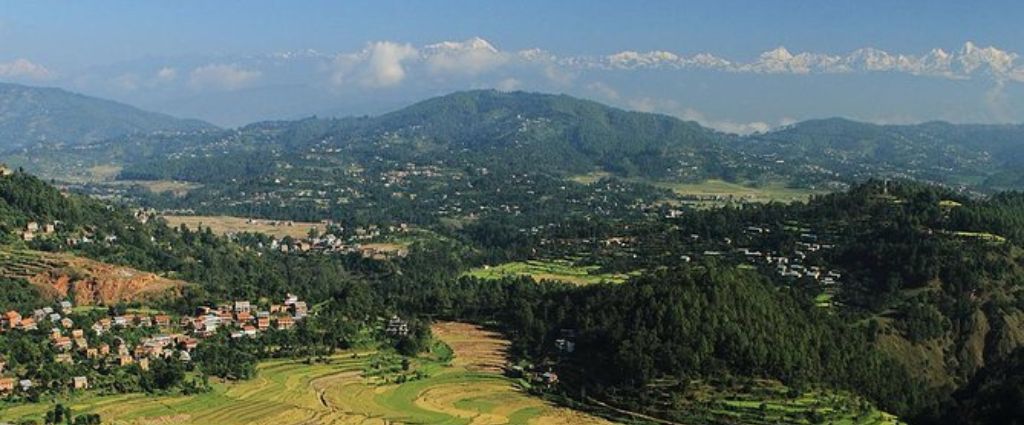
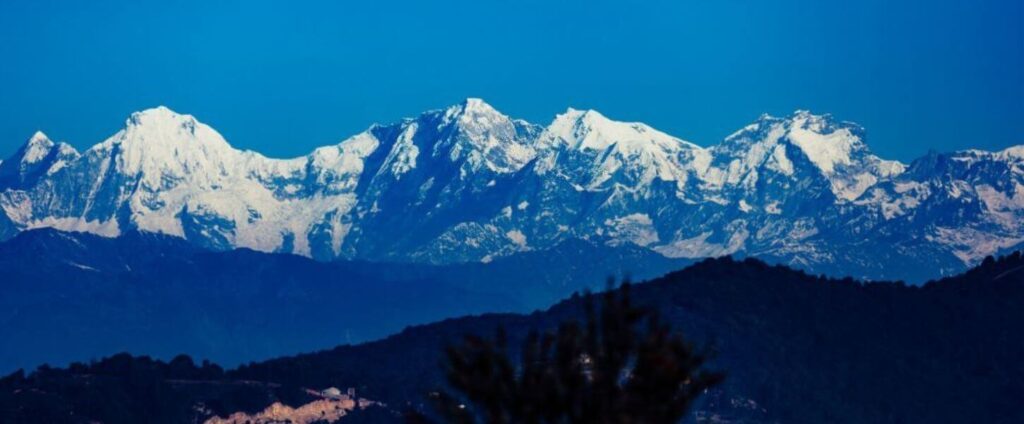
One such location is Dhulikhel in the Kathmandu Valley, which provides beautiful views of the high Himalayas and the range of peaks that it is made up of, starting with the Langtang Lirung in the west and continuing with the Dorje Lakpa, Gauri Shankar, and Melungtse, before ending with Numbur in the east.
To take in these expansive views, you must be ready to climb a bit higher than the settlement. Dhulikhel is a genuine Newari town and is, therefore, the ideal spot to come to if you want to explore the authentic culture and tradition of the region; it is unlike Nagarkot, which is also a well-liked tourist destination in the same region.
This is possibly why visitors frequently stay for about two nights to fully explore this adorable tiny town and enjoy the mountain sunshine. There are also leisurely walks all over the hamlet, so visitors can explore on foot.
Every day, the resorts in Dhulikhel offer the ideal setting for taking in the dark and dawn. Dhulikhel is a lovely city, situated 30 kilometers outside the Kathmandu Valley. The naturally lovely location has a wide range of cultural influences.
Once at Dhulikhel, it appears as though everyday obligations have already passed.
One may enjoy the breathtaking panoramic views of the mountain ranges of Langtang, Mt. Duje Lakpa, Melungtse, etc. from this location at the foot of the mountains. Numerous attractions at the well-liked tourist location make visitors yearn for the city.
Discover the amazing beauty of Dhulikhel by visiting these places. Here we have mentioned the best places to visit in Dhulikhel:
The Newari people are the residents of Dhulikhel. As a result, the city not only has stunning natural scenery and scenery but also has the traditional locals’ cultural aspects.
Numerous Hindu temples can be found nearby, which enhances the local culture. The list of cultural landmarks that one can visit to have a phenomenal feel for the culture in Dhulikhel includes Shiva Temple, Kali Temple, Ganesh Temple, Chandeshwori Temple, Hari Sidhhi Temple, Bhagwati Shiva Temple, and Gita Temple.
The heritage tours of the temples and shrines are a serene activity you shouldn’t miss. Additionally, the Kailashnath Mahadev Statue is located in Dhulikhel.
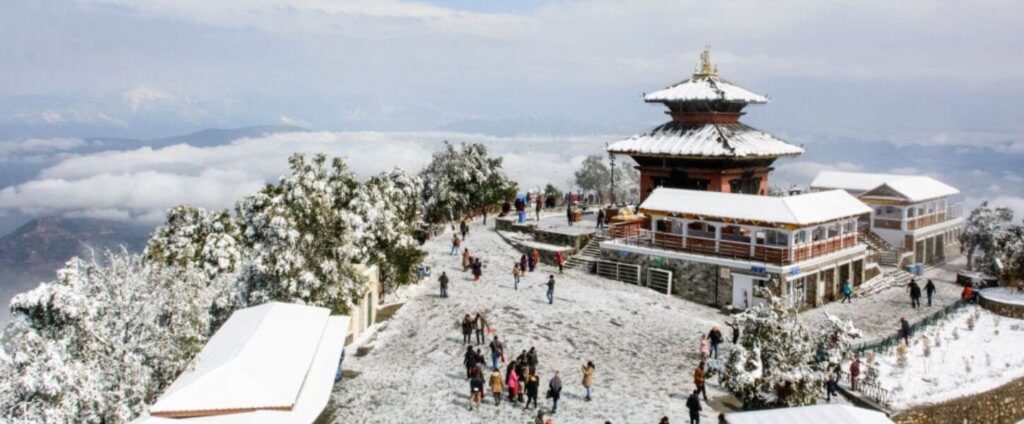
One of Dhulikhel’s most notable attractions is the selfie stone. The stone is next to the Kali temple on top of a hill. The route to the Kali temple involves climbing 1000 stairs (Hajaar Sidi). Walking up the hilltop is enjoyable since it leads to a view worth it. The beautiful view that can be seen from there makes one happy inside.
The hill’s gorgeously placed selfie stone attracts people to take pictures there. The beautifully oriented stone features a breathtaking picture of the Himalayas, lush hills, and communities, which makes it a priceless memory to record.
Namo Buddha, one of the three principal shrines, has significant religious and historical significance. According to the Buddhist religion, the three sanctuaries of Bouddhanath Stupa, Swayambhunath, and Namo Buddha are the sources of peace and harmony.
It is located in Nepal’s Kavre District, just 13 kilometers from Dhulikhel and 43 kilometers east of the Kathmandu Valley. It’s also fascinating to see the scene from the forest’s distance. On the other hand, as soon as you arrive at the location, the built-in monastery, statues, and wall paintings will fill you with a sense of calm.
The monastery was initially constructed as a location for individuals to study Buddhism, engage in rituals, offer prayers, and safeguard the Buddhist faith’s significant sites. The monastery’s building transformed it into a stunning, crucial religious landmark that is now popular with domestic and foreign tourists.
A fantastic day adventure in the middle of nature is the Namobuddha Balthali Day Hike. After investigating Namobuddha Monastery’s magnificent and distinctive architectural features and spiritual atmosphere, it starts there.
As you descend the slopes, you travel past orange groves, explore the local ethnicities, cross a suspension bridge, and then tour the lovely Balthali village. After finishing the hike at Khopasi, continue driving to your destination.
Also Read: Kathmandu Tour Guide | Kathmandu Sightseeing And Things To Do
The highest Shiva statue in the world stands over 140 feet tall and is made of zinc, copper, steel, and cement. This famous site, near Dhulikhel in Sanga, has breathtaking views and receives thousands of people each week.
This 144-foot tall statue, which represents the hand gesture (or mudra) bringing blessings of peace, was finished in 2011 after seven years of building. It is located about 12 miles east of Kathmandu. Shiva is made of copper, zinc, concrete, and steel and is almost as tall (151 feet) as the Statue of Liberty. The Hindu deity is also the second highest in the globe.
Shiva is accompanied by his recognizable trident, which symbolizes his three roles as creator, preserver, and destroyer, as well as a damaru (drum), which he employs in his dance. The serpent Vasuki, who stands for strength and bravery, also garlands Shiva.
Shiva is accompanied by Nandi, a bull that stands in for Pashupati, or “Lord of Cattle,” another of Shiva’s guises. There are 12 Shiva lingams around the statue in the temple complex, which, depending on the source, may or may not be phallic symbols. They signify Shiva’s function as a creator and fertility deity.
Mahadev means “great god,” whereas Kailashnath means “Master of Mount Kailash.” Shiva’s traditional residence, Mount Kailash, is a 21,800-foot-tall mountain in China’s Tibet Autonomous Region, close to the northwest corner of Nepal. It is close to the Indus, Brahmaputra, and Karnali rivers’ sources.
Earlier this year, a new 738-foot pedestrian suspension bridge was built over the congested Araniko Highway to make it easier for pilgrims and visitors to reach Shiva’s mount. Even without the climb up to the monument, the views of the Himalayas and the Kathmandu Valley from the bridge are worthwhile.
Talking about the Dhulikhel Zip Line Experience, have fun and let your heart race as you soar into the air over breathtaking sites. We will pick you up from your Kathmandu hotel and drive you to the activity site to begin the tour. You will meet the expert there.
You get assistance from an expert with the safety gear. The 72-meter plunge follows the safety check. Awe-inspiring scenery in Dhulikhel is waiting for you on this excursion. Start now and make memories worth sharing that will endure a lifetime.
Dhulikhel Zip Line Experience hours are 7:00 am, 10:00 am, and 12:00 pm.
Most of the Kathmandu Valley Cultural Trekking Trail is located in Dhulikhel Municipality. This five-day journey offers a quick hike with the Himalayas in the background, and it goes through areas with a diverse population of animals and plants.
Visiting hill stations like Chisapani, Nagarkot, and Dhulikhel will be exciting and rewarding and are the best places to visit in Dhulikhel. One of the beginnings or midpoints of hiking routes is the municipality of Dhulikhel.
These include walks that can take up to a half day to Panauti, Kavre Village, Opi Village, and Hazaar Sindhi. A longer walking path includes the Namobuddha and Nagarkot trails.
The municipality is also one of the locations for mountain biking, offering rugged terrain in addition to the presence of people from diverse ethnic backgrounds and beautiful mountain landscapes. There are routes from Dhulikhel to Panauti, Khopasi, Palanchowk, and Namobuddha, among others.
A beautiful panorama of Dhulikhel’s snow-covered mountains. The lower slopes of the mountains seem to float in the air when a blue haze surrounds them. The welcoming green hills, some of which are still undeveloped and some have been transformed into exquisitely carved agricultural terraces, are pleasing to the eye.
Are you planning your Kathmandu tour? Do you need a Kathmandu tour guide to visit Kathmandu? Kathmandu is the capital city of Nepal, founded in the 2nd century CE by the bodhisattva Manjushri. A doorway to the Himalayas, it was once ranked among the top three upcoming travel destinations in the world by Tripadvisor.
This valley has a great deal of culturally and archaeologically distinctive places that you can visit. During your Kathmandu Tour, you will experience a cultural, religious, and spiritual exploration.
The old town of Kathmandu, the royal palace, and important religious sites are worth visiting in the city center. If you want to see some scenery, you have to go outside the city, but you will be in the Kathmandu valley, not the Himalayas. Kathmandu is a good choice if you prefer to visit historical sites and places with natural scenery.
Given below is a list of twenty popular places to explore within Kathmandu city:-
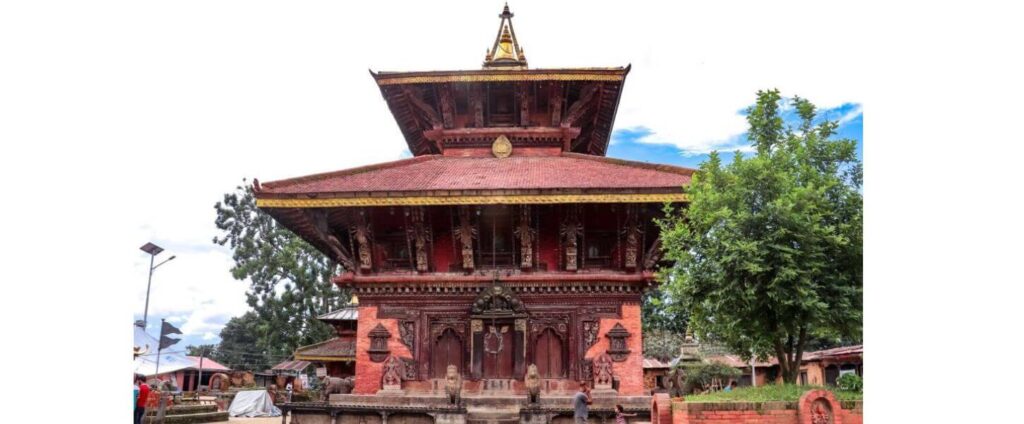
This religious site lies north of Bhaktapur, an ancient temple on a hilltop surrounded by champak forests. The Changunarayan Temple is the oldest in Nepal, and it was built by King Haridatta Burma as early as the 4th century.
It is dedicated to Lord Vishnu, the supreme deity of the preservation of cosmic order. A UNESCO World Heritage Site featuring complex wooden and stone carvings, it is located approximately 7 kilometers north of Bhaktapur Durbar Square. Changunarayan temple is one of the highlights of your Kathmandu tour.
It is believed that the two-story Vishnu temple was not constructed in the shikhara or pagoda styles. But it is built in the pagoda style. The Lichhavi dynasty’s past is preserved in this ancient temple in the style of Nepal.
The northern hill town of Bhaktapur is home to this well-known shrine. It is around 7 kilometres away from Kathmandu. The oldest artefacts, dating to 464 CE, were found in this temple and included inscriptions and sculptures. As a result, King Manadeva, one of the most fabulous kings of the Lichhavi kingdom, is believed to have found it.
There are four doorways on the temple’s exterior, one in each direction. A pair of lions, sarabhas, gryphons, and elephants are stationed on either side of each entryway.
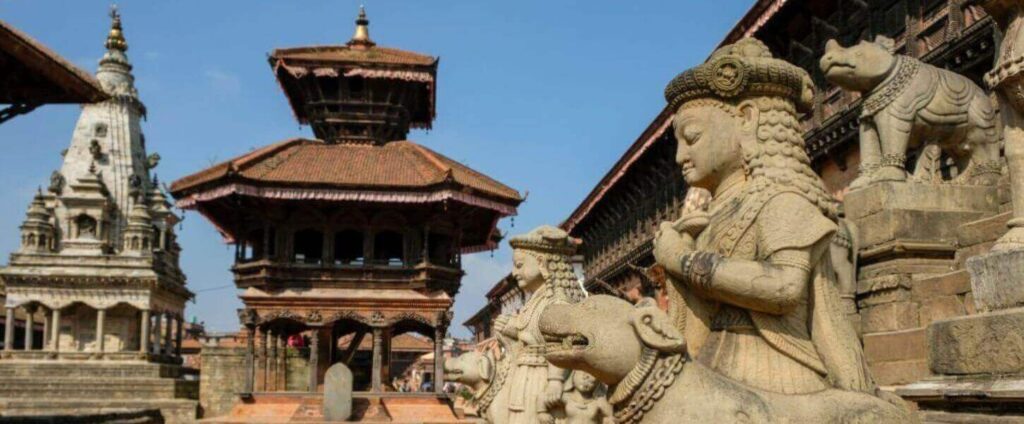
Probably the top tourist attraction in Bhaktapur, it is an ancient royal palace home to the Malla Kings from the 14th to 15th century and the subsequent royal families in the Kingdom of Bhaktapur.
Numerous courtyards, temples, and palaces inhabit the surroundings of this royal site. The 55-window palace (Nge Nyapa Jhya Laaykoo), characterized by its intricate wooden carvings, is located on this site.
An artificial pond near the entrance of the main Bhaktapur Durbar Square, this structure was established in the 15th century by King Yakshya Malla.
This area includes a terracotta temple—a model of the Kedarnath temple in Uttarakhand, a rounded temple corresponding to the Ramanathaswamy Temple of Tamil Nadu, and a pagoda-style temple similar to the one in Puri, on the eastern coast of India.
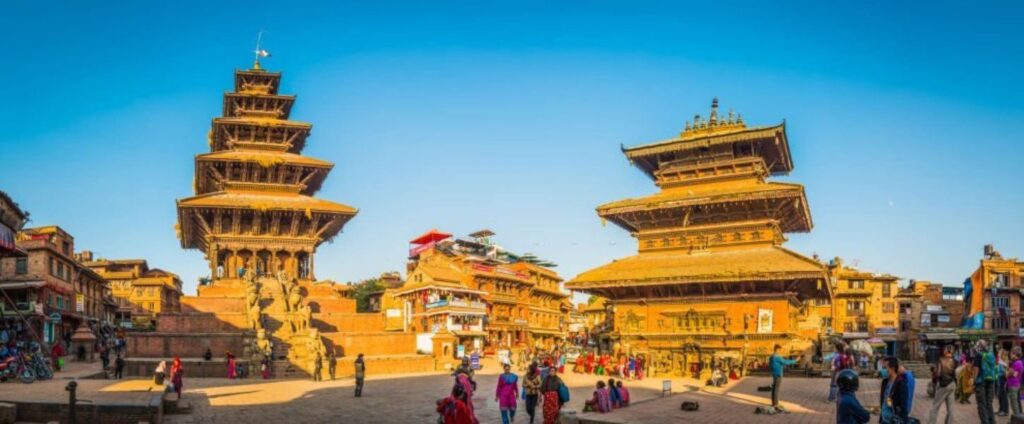
One of the most prominent landmarks within Durbar Square, this five-storied temple is the city’s highest monument and also the tallest temple in Nepal. The construction of this temple was ordered by King Bhupatindra Malla (1696 – 1722).
He is the most acclaimed ruler of the Malla Dynasty, titled ‘nepaḥ juju,’ meaning king of the newars. This temple has withstood four major earthquakes (fingers crossed!) and is an iconic representation of the Newari Culture. It stands tall and mighty in an area called Taumadhi Square.
A metallic statue of King Bhupatindra Malla can be found near Taleju Bell (Tagou Ghan), near the Nyatapola Temple. The king is depicted paying his respects to the religious deities in a crossed-leg posture, seated above snakes on a lotus.
They are also known as Tachapal Tole, Bhaktapur’s most ancient square. Located away from the leading site of the Bhaktapur Durbar Square, it is the least visited of the four squares in Bhaktapur. The Taumadhi and Main Durbar Square lie west of this site.
Dattatraya is a coalescing form of the three deities of Lords Brahma, Shiva, and Vishnu. Inside the temple, you will find images of Som, Durbasha, and Dutt. King Yaksha Malla (1428 – 1482 AD) is believed to have built this temple.
The temple’s first floor features erotic carvings, widely considered a worldly test for all devotees. Around the Dattatraya temple, you will come across the Peacock Window (Wooden Carving), the Bhimsen Temple, and the Laxmi Narayan Temple.
Panauti is an ancient region in Nepal that was originally offered as a dowry to his sister by King Bhupatindra Malla. With fewer than 15,000 residents, this town is home to a few notable landmarks like the Panauti (Layaku) Durbar square and the Indreswor shrine.
Alongside Kathmandu, Patan, and Bhaktapur—all past capitals of the Kathmandu valley—Panauti was finally incorporated into the unified kingdom of Nepal at the end of the 0th century. Along the historic Salt Trade route connecting Tibet and India, Panauti served as a major commerce station. In reality, Panauti has a history that has been documented from the first century AD.
A medieval site with many religious Buddhist and Hindu monuments, It is considered to be the most artistic town in Nepal, after the Kathmandu Valley. Places to visit here—A durbar square, the Indreshwar temple, and the Unmatta Bhairav Temple.
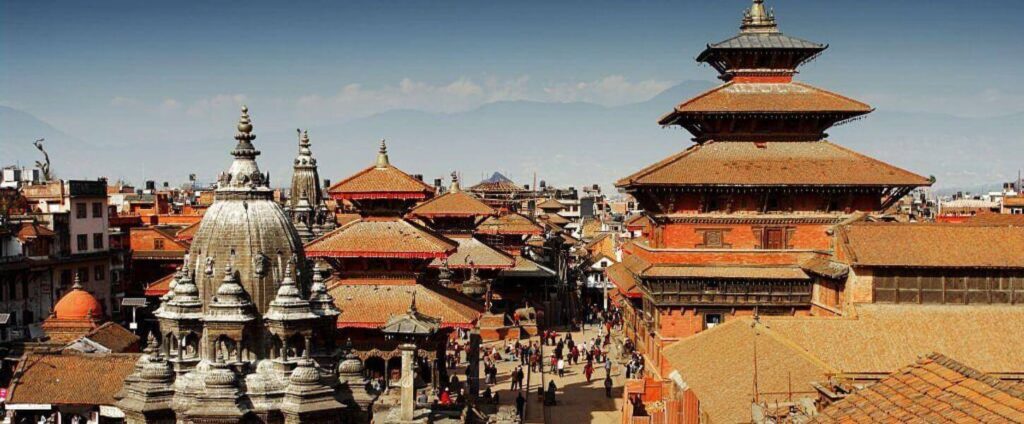
A UNESCO World Heritage Site, this site is a former royal palace of the Malla Kings in Lalitpur. The area hosts numerous temples and historical, art, and cultural exhibits. Patan Durbar Square is among the main highlights of your Kathmandu Tour. The main attractions within Patan are described below.
This museum is in the northern part of the durbar square area and exhibits traditional holy arts in an impressive architectural setting. It has around 1,100 relics, and most of the pieces are cast bronzes (mainly statues of Hindu and Buddhist deities) and polished copper works.
Mul Chowk is the central courtyard in Patan Durbar Square, with the Vidya Temple at its center and the Taleju temples surrounding it. It stands north of the Sundari Chowk and is the largest of the three courtyards in Patan.
Sundari Chowk’s exquisite courtyard has a gateway guarded by three magnificent statues of Hindu gods Hanuman, Ganesh, and Narsingha. A Royal Bath, called the Tusha Hiti, is positioned in the courtyard. The walls of this bath have several idols made of copper.
The most significant temple in Patan Durbar Square, this three-storied structure, was built in a local rendition of the Shikhara style known as the Granthakuta. Carvings on the temple walls and pillars narrate the Ramayana and Mahabharata events.
A historic Buddhist Monastery used for coronation ceremonies, this is assumed to be the oldest monastery in Patan. The monastery is two stories high and has a golden door guarded by two brass lions.
King Bhaskar Varman built this golden pagoda of Buddha in the 12th century. Four stories high with gold-plated roofs, the exterior of the building depicts scenes from the life of Buddha.
On the ceiling of the entrance, you will find a Kalachakra Mandala, which is the wheel of time—displaying life cycles.
Popularly known as the temple of a thousand buddhas, this temple was designed in the Shikhara style of architecture, with terracotta tiles of Buddha iconographies. It is a few minutes from Patan Durbar Square’s main site.
Situated in Jawalakhel, the central zoo of Kathmandu provides habitat to more than 850 species, and fifteen endangered species are protected within the 15-acre confines of this territory.
It offers activities like paddle boat tours, picnic sheds, children’s playgrounds, an aquarium, and a dedicated library.
Kirtipur is an ancient city of the Newars, 5km south of Kathmandu. It holds great historical significance to the Kirati Kingdom under King Yalamber and is a center for Newari Culture. You will get a glimpse of traditional Newari society in this area.
On the northwest side of the Kirtipur hill is a three-tiered, Newari pagoda-style temple made of brick and wood. The temple is also known as Bhavani Shanker, and it was constructed in the mid-16th century to honor Lord Shiva and his wife, Parvati.
Bagh Bhairab is a Hindu Temple in Kirtipur dedicated to Shiva’s incarnation as a tiger. Built-in the 16th century, this incarnation of Shiva is believed to protect the town.
It is one of the earliest shrines in Kirtipur, and it features a clay deity with a large silver mask that portrays Bagh Bhairab.
This tourist spot is in the southwestern part of the Kathmandu Valley and can be reached via cable car ride. This area provides a bird’s eye view of the entire valley and the Himalayan Ranges from Annapurna to Mt. Everest. Chandragiri Hills is also one of the highlights of your Kathmandu tour.
Designed by Shankar Nath Rimal, this pagoda-styled temple was built to pay homage to Dakshayani (Sati Devi), the first spouse of Lord Shiva.
With over 50,000 specimens of flora and fauna, this museum, established in 1975, is the scientific authority for the Convention on International Trade in the endangered species of Flora and Fauna (CITES). It is situated close to the Swayambhunath Stupa.
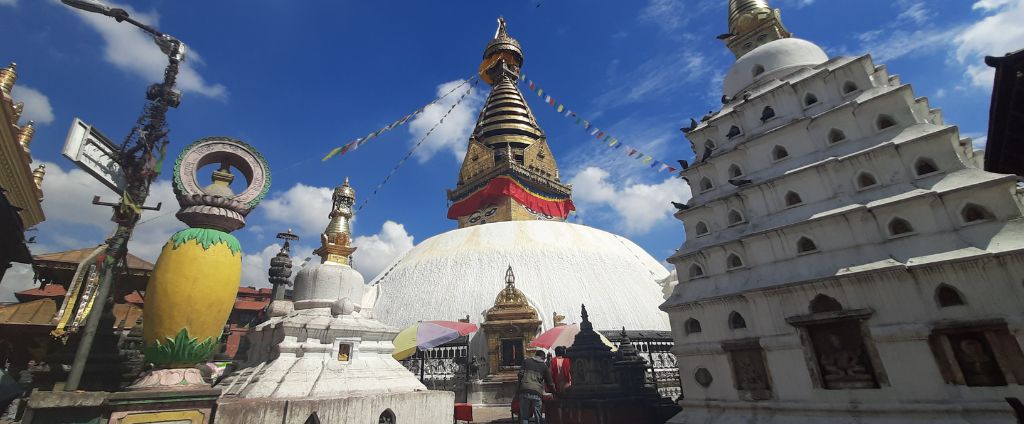
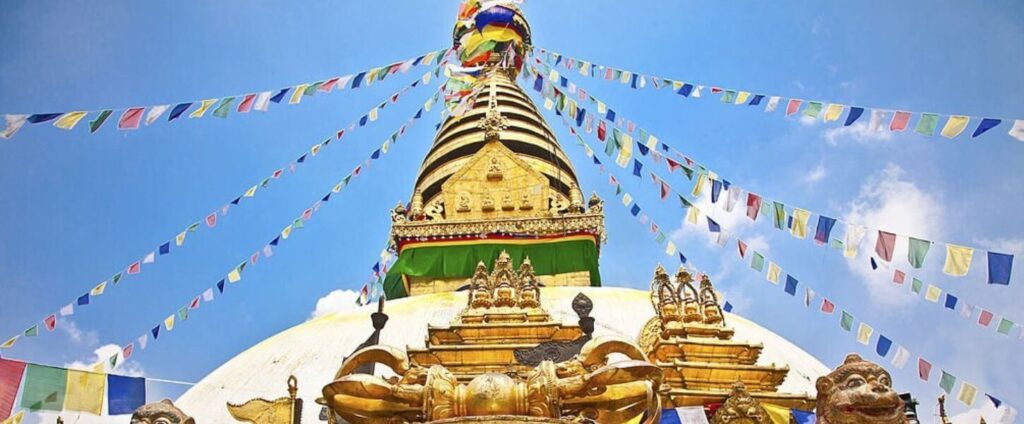
A Buddhist Monastery on a western hill of the Kathmandu Valley, this ancient site has a stupa with the facial features of Buddha painted on its main Harmika. A visit to Swayambhunath stupa is a must during your Kathmandu tour.
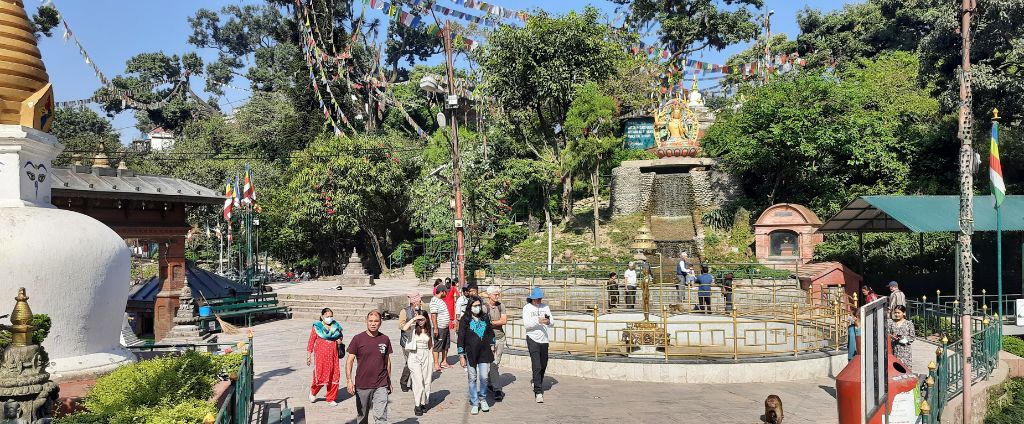
Swaymbhunath, a tiny mountain northwest of Kathmandu Valley, is a place of tranquility and prayer. Since the 1970s, visitors who found the name difficult to pronounce have referred to it as “Monkey Temple.” Visitors can get a birds-eye perspective of the city from Swayambhu, which dominates most of the valley.
With Hindu temples and goddesses interwoven into this Buddhist landmark, the stupa has stood as a symbol of faith and harmony for generations. It is where the splendor of the Kathmandu Valley is believed to have begun.
This Gompa is located further north of the Swayambhunath Stupa (4.5kms away), outside the vicinity of the ring road of Kathmandu, and it falls under the Nagarjun District. An exemplary work of Tibetan Architecture, the murals, and statues here is an exquisite sight to witness. Scenic sunrise/sunset views can be seen from this hillock.
The monastery is a stunning example of Tibetan architecture, filled with numerous murals, statues, and paintings. You may also enjoy this monastery’s stunning views of the Kathmandu valley. If somehow the weather is clear, you may even be able to see the stunning mountain range. After the Nagarkot, White Gumba is the second-best location to see the dawn and sunset. Many people come to this location to watch the breathtaking dawn and sunset from the hill.
Every area of the monastery reflects a sense of calm and peace. People are compelled to take images of The White Gumba (White Monastery) due to its stunning design and aesthetic. Visitors are drawn to the White monastery because of its stunning scenery.
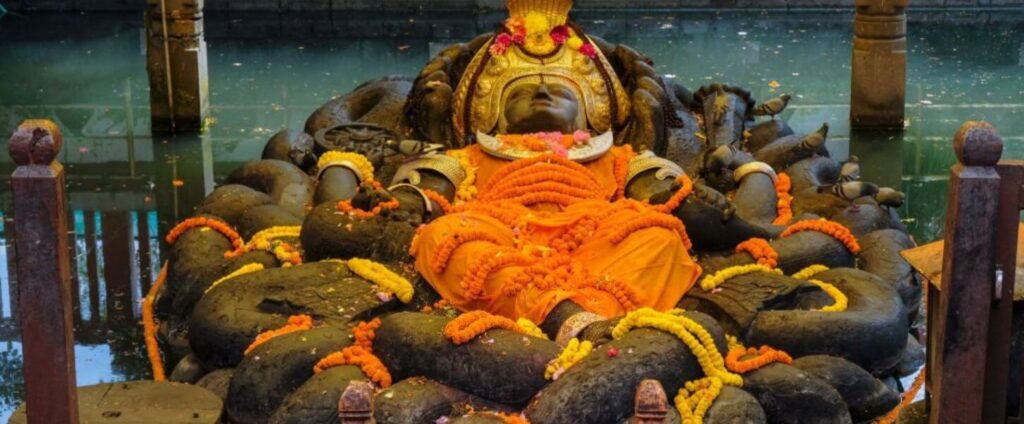
This temple features a supine statue of the Lord Mahavishnu, resting atop a coiled serpent called the Shesha—the serpent king of the Nagas. Budhanilkantha is translated as ‘old-blue throat,’ which is named so because Lord Shiva supposedly drank poison to save the world.
The water here is said to have originated from the Gosaikunda lake after Lord Shiva struck his trident into the ground. The Budhanilkantha Temple is located beneath the Shivapuri Hill at the northernmost point of the Kathmandu valley. It is situated in the Kathmandu District’s Budhanilkantha municipality.
Shivapuri national park, established in 2002, is a vital drainage basin that supplies water to the entire Kathmandu Valley. It is a popular hiking route with a wide diversity of flora and fauna. The park is situated in the northern part of the Kathmandu Valley, and it hosts an extensive 177 species of birds.
Shivapuri Nagarjun National Park covers 159 square kilometers and is 12 km from the capital city’s center on the northern edge of the Kathmandu Valley. In 2002, the region was designated the eighth national park. The Shivapuri Watershed Development Board governed it before being designated as a national park, and it was subsequently named the Shivapuri Watershed and Wildlife Reserve.
Between a subtropical and temperate environment, Shivapuri is located. Depending on altitude and aspect, the vegetation comprises several natural forest kinds, including pine, oak, rhododendron, etc.
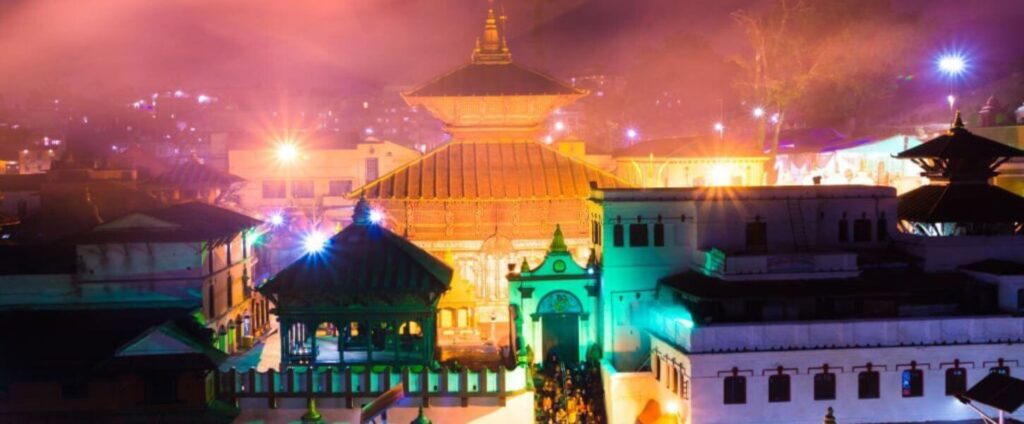
This holy site is an important pilgrimage site for Hindu devotees worldwide, near Kathmandu’s Tribhuvan International Airport. The temple holds special significance for Lord Shiva, and MahaShivaratri is a major festival celebrated here.
It is believed to be one of the most significant Shiva temples on the entire continent. A Licchavi-era king by the name of Prachanda Deva built this religious site. A visit to Pashupatinath temple is a must during your Kathmandu tour.
The Taragaon Museum is located on the grounds of the Hyatt Regency Kathmandu and is only a short distance from the Boudhanath Stupa. It was originally constructed in 1972 by Carl Pruscha and reopened in March 2014.
The Taragaon Museum aims to capture the 50 years of anthropologists, painters, photographers, and architects from abroad who studied the Kathmandu Valley during the later half of the 20th century and worked to preserve its cultural history. The Museum displays the rehabilitation and restoration work done to preserve Kathmandu’s cultural and architectural legacy.
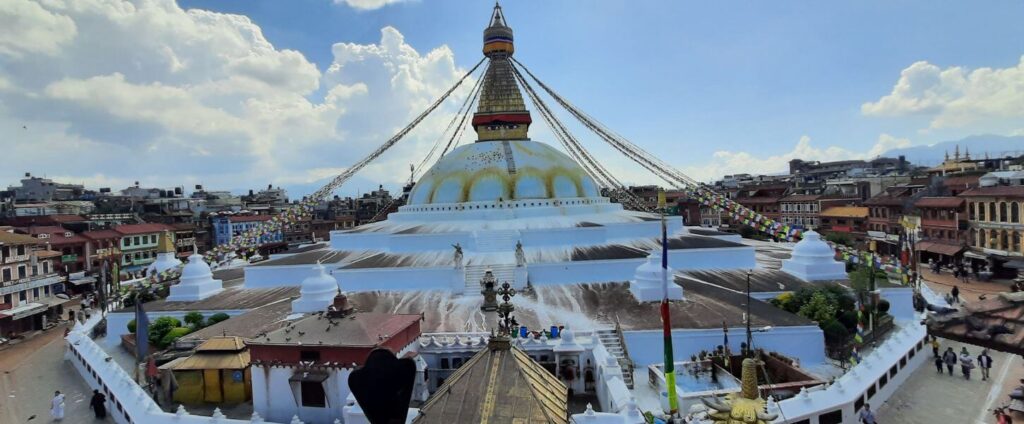
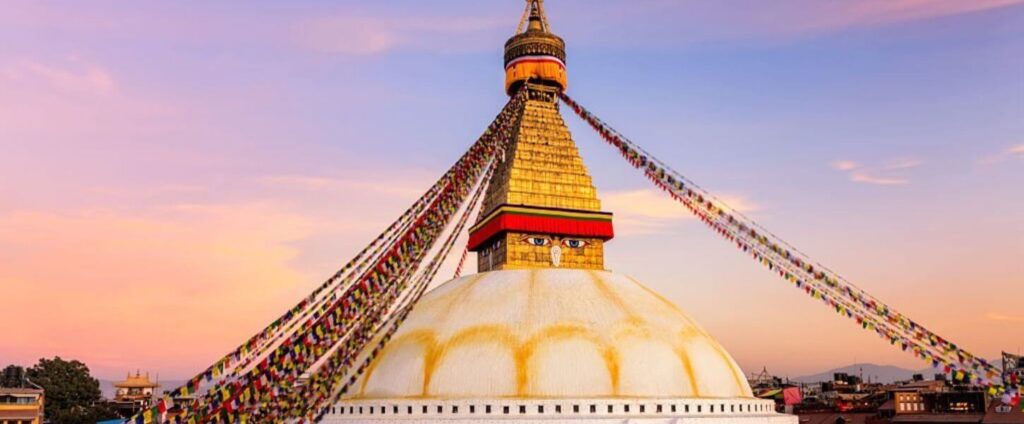
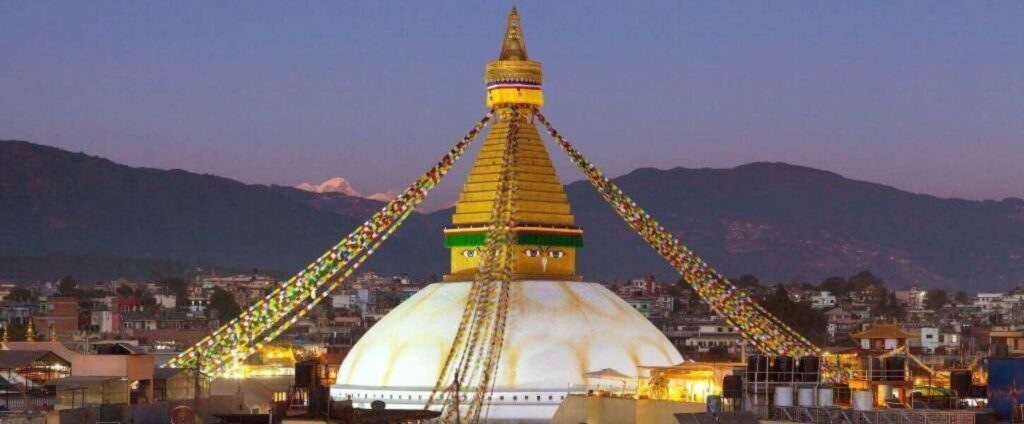
Located in Kathmandu, Nepal, Boudhanath, also known as Boudha, is a stupa. The relics and remnants of Buddha are kept inside the semicircular Boudha stupa. The stupa is one of the biggest circular stupas in the world due to its enormous mandala.
Among the most popular tourist attractions in Kathmandu is the Boudha Stupa, inscribed on the UNESCO World Heritage List in 1979. The stupa was constructed by a Tibetan ruler in 600 AD. All Buddhists worldwide visit the stupa as a place of historical pilgrimage. Many kilos of gold were used in the stupa’s ornamentation during construction.
Three enormous platforms that get smaller make up the stupa structure’s base. These platforms stand in for the sky, while the semi-sphere is supported by a circular vase representing water.
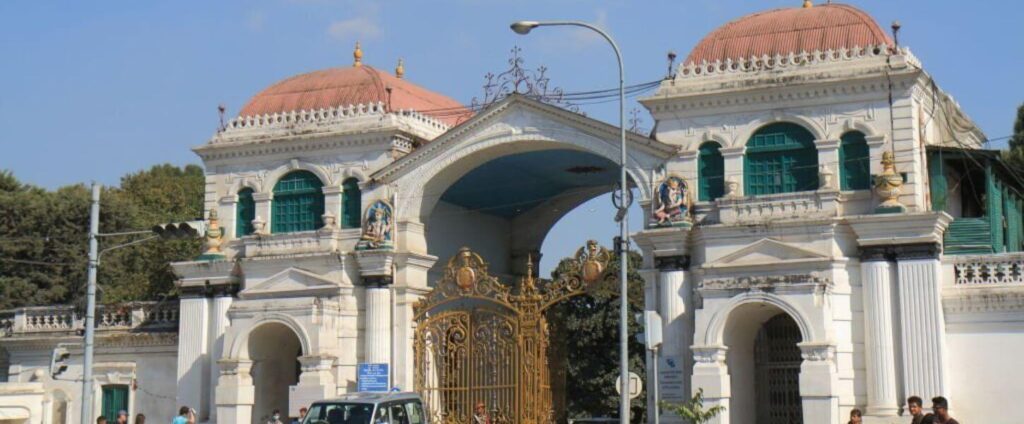
This former palace in central Kathmandu is now a government office. It was established in 1908 and is the largest palace in Asia. The Rana Dynasty built the Durbar, with seven courtyards and an astonishing number of 1700 rooms.
The huge and majestic Singha Durbar, also known as Lions’ Place, was constructed in Nepal in the early 19th century in the neoclassical style. This palace may be found in Kathmandu, east of Bhadrakali and north of the Babar Mahal. According to legend, this was the largest structure ever constructed in Nepal a century ago. Before their demise, the Rana Prime Ministers resided permanently in this building. The government of Nepal currently governs it.
One of the Rana prime ministers during the 19th century, Chandra Shumsher Jung Bahadur Rana, built this enormous compound as soon as he was appointed prime minister of Nepal. It started as a modest home owned by the Rana family.
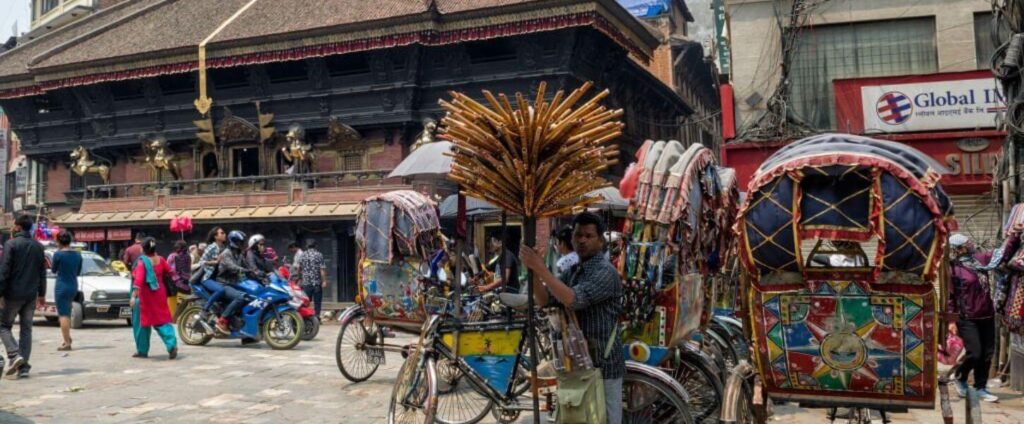
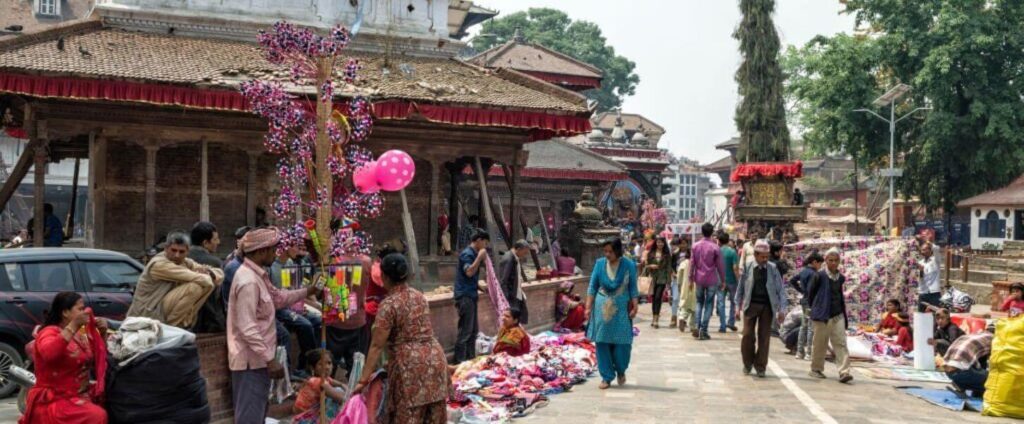
Asan is the leading market square of Kathmandu, with hectic crowds and a bazaar. Many shops and vendors with various handicraft stores can be found here.
Different merchandise, including spices, food, textiles, and electronics, are sold here. Like any other area in Kathmandu, many temples are also found around this area.
The Kathmandu tour is incomplete without wandering through these streets and, most likely—losing your way in this locale.
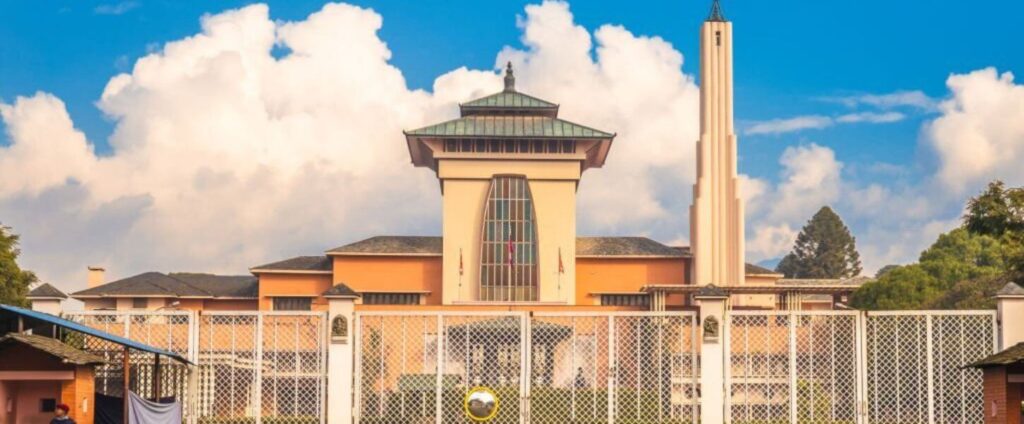
A former residence of the principal Monarch of the Kingdom of Nepal, this Palace is now a museum. It is the landmark that witnessed the greatest tragedy in the history of Nepal, the Kot Massacre.
The Palace was built by king Mahendra during his reign in 1963. You can visit Narayanhiti Palace Museum on your Kathamndu tour if you want to witness the history of the Shah dynasty of Nepal. There’s something majestic about the palace that makes you feel like a king or queen.
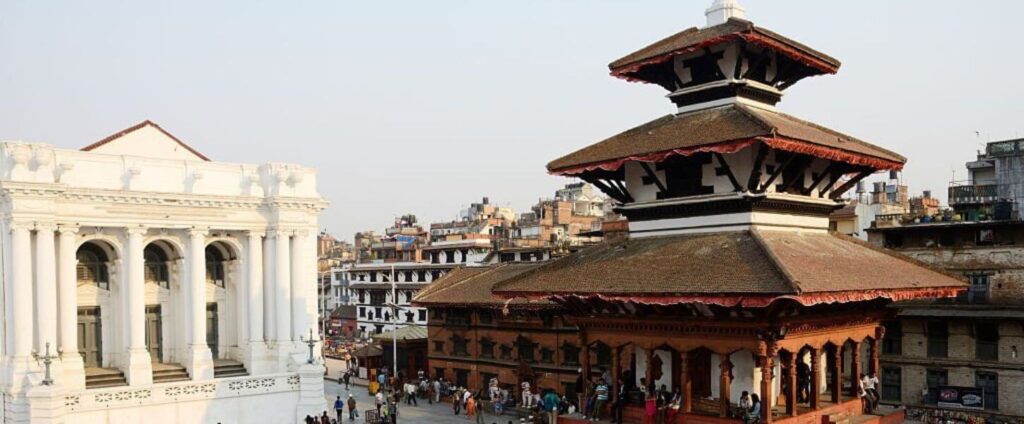
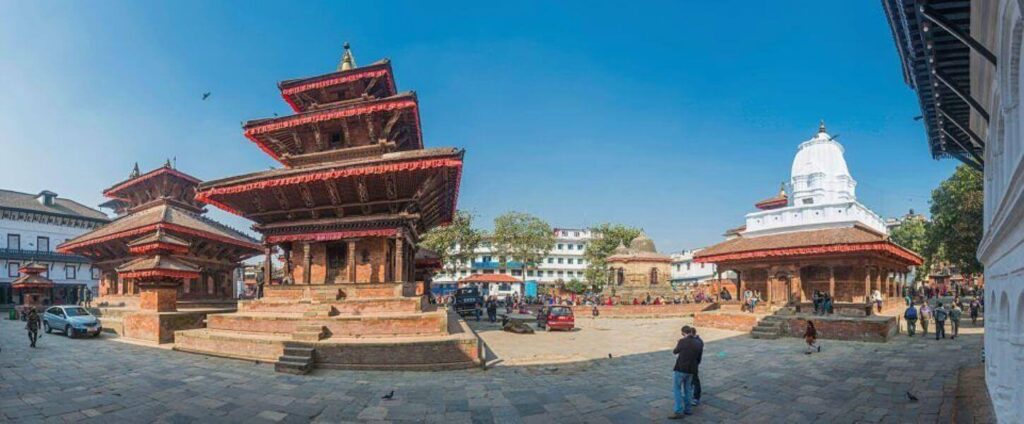
Kathmandu/Basantapur Durbar Square is a UNESCO World Heritage Site within the valley, a residence for the former royalty in the preceding centuries.
The area features many structures, including temples, courtyards, monasteries, and museums. A Cultural Heritage of the Newari Community, with Hindu and Buddhist-influenced architecture, can be observed on this site.
One of the leading market squares of Kathmandu, it is an intersection of six significant streets—Makhan, Jana Baha, Naxal, Durbar Square, Maru, and Asan Bazar. Indra Chowk is a commercial hub that is populated by various street vendors.
The junction comes to life during the prominent Newari festival of Indra Jatra. Indra is the king of devas, associated with manipulating the weather and war.
Make sure to check out all these sites during your stay in Kathmandu. You can contact us for a guided Kathmandu tour of these popular points of interest in the valley, ensuring a memorable, informative, hassle-free Kathmandu tour.
Attractive Travels and Tours Pvt. Ltd. employs a team of enthusiastic, knowledgeable, and skilled tour directors, tour guides, trekking leaders, and field personnel.
Prakash Aryal, the No. 1 Kathmandu Tour Guide, is among the many well-known Kathmandu tour guides. Since 2014 AD, he has worked as an expert tourist guide for Attractive Travels and Tours Pvt. Ltd. in Nepal.
Mr. Aryal is also a founding member of AHRD Nepal, an NGO that works to improve rural communities in Nepal, particularly in education, awareness, health, and orphans, particularly in Chepang Village in Jogimara, Dhading District.
Mr. Aryal’s desire to provide his clients with the best possible service motivated him to earn a diploma in tour guiding from NATHAM (Nepal Academy of Tourism and Hotel Management).
Travelers from all over the world have made Kathmandu something of a destination. Given the city’s captivating fusion of artistic and cultural legacy and close proximity to the Himalayas, it is simple to understand why. Join us on a private Kathmandu tour guide and see this city’s numerous delights.
Durbar Square, located in the centre of the ancient city, is a must-see for anybody travelling to Kathmandu because of its distinctive architecture and friendly attitude. With the help of your Kathmandu tour guide, go around the Old Town’s twisting, crooked lanes, stopping to eat momos that have been steaming or look at the local crafts.
A day journey to the area’s World Heritage-listed sites, Swayambhunath, Pashupatinath, Bodhnath, and Patan, is highly recommended. Additionally, your Kathmandu tour guide should be pleased to assist you with a trek in Champa Devi or Shivapuri National Park to reach the verdant mountain beauty around the Kathmandu Valley.
The capital city of Nepal, Kathmandu, is where you’ll probably arrive first while traveling there. But don’t make it a quick stop on your journey; it’s worth lingering along and taking in the ambiance of this fascinating city. The most intriguing things to do in Kathmandu range from spirituality and shopping to heritage, architecture, and culture. Here are some tips for maximizing your time there.
The Kathmandu Valley, whose communities have maintained a traditional way of life unaffected by contemporary development, is a great place to escape Kathmandu’s traffic and urban sprawl. Located south of Kathmandu and close to Patan, Bungmati and Khokana are two of the most well-liked villages to visit. These two villages need tourism more than ever because the 2015 earthquake severely damaged them.
Rato Mahhendranath, a respected rain deity, is thought to have been born in Bungmati hamlet, which goes back to the sixth century. Unfortunately, the earthquake destroyed his temple. Thus his idol is currently preserved in the adjacent Patan. You may visit the villagers’ workshops to see the woodcarvers and sculptors at work. Khokana is a prosperous farming community where mustard oil is produced, and locals work in agriculture for most of the day.
The Shivapuri Nagarjun National Park, which is around two hours from Kathmandu and offers more than 61 square miles of nothing but nature, is situated along the valley’s northern side.
Nepal’s ninth national park, which was once a watershed and wildlife reserve, is now a popular trekking destination. This area is home to numerous rhododendrons, pine and oak trees, Himalayan black bears, rhesus monkeys, leopards, 177 bird species, 102 butterfly species, and 129 mushroom species.
Wandering around the exciting maze of tiny alleys and passageways in ancient Kathmandu will keep you occupied for hours, if not days, from Durbar Square to Thamel.
Grab a map, and start exploring—you might be shocked to find shrines and sculptures tucked away in unexpected locations! Indra Chowk, a bustling market area where five roads meet, may be reached by traveling down Siddhidas Marg from Makhan Tole, situated on the northeastern corner of Durbar Square.
The Seto Machhendranath Temple, one of Kathmandu’s most elaborate temples, can be found at Kel Tole if you continue straight down Siddhidas Marg. You will arrive at Ason Tole, the busiest intersection in Kathmandu, as you continue down Siddhidas Marg.
From dawn until dusk, a mesmerizing throng of people travel this route, selling produce from all over the Kathmandu Valley. Spending some time here taking it all in is worthwhile. Additionally, there is a magnificent Annapurna, the goddess of plenty, a temple with three stories that draw pilgrims.
After approximately five minutes, turn left into Chittadhar Marg, then right onto Chandraman Singh Marg and keep going until you reach Thahiti Tole, where there is a Buddhist stupa from the 15th century and the Lord Shiva-dedicated Nateshwar temple. The Kathesimbhu Stupa, a 17th-century replica of the enormous Swayambhunath Stupa situated just outside Kathmandu, dominates a quiet courtyard along the path.
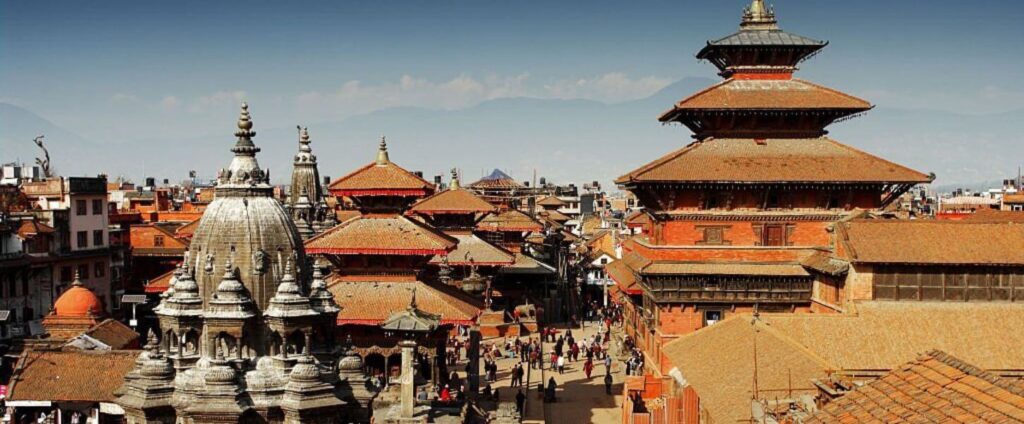
The Durbar Square in Basantapur, south of Thamel, where the royal family resided until the 19th century, is the center of Kathmandu’s historic old city. A World Heritage Site since 1979, it was designated by UNESCO.
Several temples dating back to the 12th century are both Hindu and Buddhist in nature, in addition to the Royal Palace, Hanuman Dhoka. Sadly, a massive earthquake in 2015 severely damaged other buildings, including the palace, and completely demolished the southernmost portion of the temples.
Poor maintenance, ongoing restoration projects, and the cost of admission (1,000 rupees per person for tourists) have prevented many visitors from visiting Durbar Square. However, in the Kathmandu Valley, two other ornate and significant Durbar Squares may be found in Patan (500 rupees for foreigners) and Bhaktapur (1,500 rupees for foreigners).
Despite the earthquake’s low impact on both, these sights provide far greater value for the money and are unquestionably worthwhile visits. Several businesses offer private excursions, including this Patan and Bhaktapur Day Trip from Breakfree Adventures.
The easiest way to enjoy Thamel is on foot, but be careful because the neighborhood may be busy with traffic. The Thamel District is undoubtedly one of Kathmandu’s most well-liked tourist destinations and activities. Numerous restaurants, boutiques, and locations like the Garden of Dreams, a peaceful corner off the main drag inside a lovely park, may be found here.
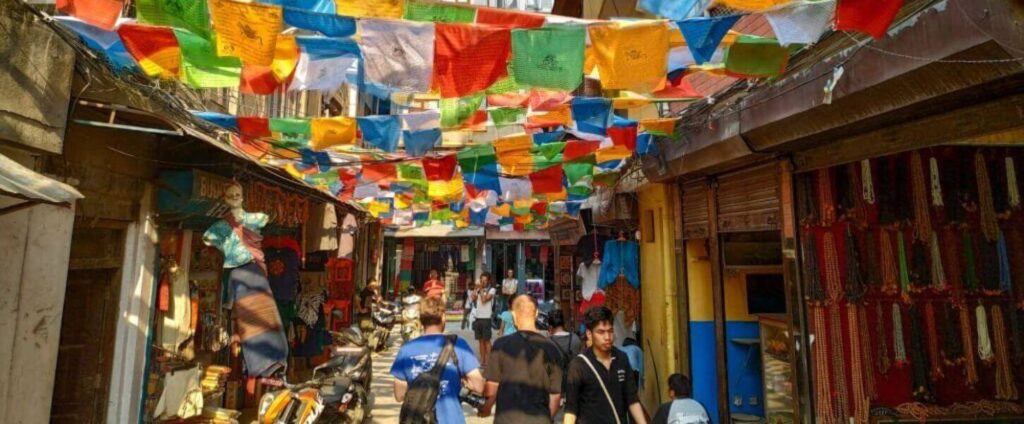
The rows of Tibetan prayer flags and cycle rickshaws that pass by in Kathmandu’s Thamel tourist zone help to maintain its old-world charm even though it is busy and chaotic at times. Shops overflowing with brilliantly colored apparel, jewellery, paper lanterns, thangka paintings, wood carvings, bronze statues, music, and literature occupy the streets of this bustling neighbourhood.
As shops may be harsh, haggle hard to achieve a decent bargain; strive to pay just a third or half of the initial suggested amount. Thamel adopts an entirely new atmosphere when the day begins to fade, with its streets glowing with the cosiness of many lights and the sound of live music wafting from its pubs.
It isn’t easy to think of anything that could be more peaceful than taking a stroll through the Garden of Dreams, which is located not far from the bustling Thamel tourist district across the street from the site of the former Royal Palace.
The 1920-built European-style garden, designed by scholar and horticulture enthusiast Kaiser Shumsher Jung Bahadur Rana, provides a quick escape from the rest of the bustling city and is available to the public every day starting at 9 a.m. It is ideal for a picnic or midday walk between noon and 6:30 p.m.
Attractive Travels and Tours Pvt. Ltd. have a group of dedicated, experienced and professional tour leaders, tour guides, trekking guides and field staffs. Among the no. of kathmandu tour guide one of the well known is Prakash Aryal- Number 1 kathmandu tour guide .
Prakash Aryal was born in Dhading district. (Central region of Nepal). He came to the Capital city of Kathmandu for the higher studies. He began his tourism career in 2007 as an office assistant while continuing his further studies. Then he became assistant tour and ticketing Officer and Manager of the Leading Travel and Trekking Company in Nepal.
He is specialized as export tourist guide in Attractive Travels and Tours Pvt. Ltd., Nepal since 2014 AD. Mr. Aryal is also the Founder member of AHRD Nepal, an NGO working in the upliftment of rural communities (especially in the field of education, awareness, health and orphans specially Chepang Village in Jogimara, Dhading District, Nepal. He has a tour guide diploma from NATHAM (Nepal Academy of Tourism and Hotel Management ) College, and continues to self-study, motivated by his wish to provide the best possible service to his clients.
1. Many of Thamel’s principal streets were made pedestrian-only in late 2017. It is now relatively easy to move about.
2. Some street-dwelling youngsters may be found in Thamel. It’s not a good idea to offer them cash.
3. Generally speaking, Thamel is not hazardous, although taking additional precautions with your belongings is advisable, particularly while out at night.
4. On weekends, lodgings along Thamel Marg might be noisy due to the clubs and live music proximity.
The Kathmandu Valley is the ideal location for a cultural introduction to Nepal. Since ancient times, the valley has been the hub of social, cultural, and economic power. You may go on a sightseeing tour of the UNESCO sites in the Kathmandu Valley. UNESCO has designated two natural and eight cultural sites in Nepal as World Heritage Sites, 7 of which are in the Kathmandu Valley. Walk through Kathmandu Valley’s cobblestone streets to discover some of the best examples of oriental architecture.
According to reports, this is South Asia’s most prominent Buddhist shrine. King Man Deb constructed the enormous historic chhorten in the sixth century A.D. From above; it appears to be in the shape of a lotus flower, which is still a highly sacred thing for all devoted Buddhists worldwide. A series of three terraces support it. A circular market, a component of Tibet town, surrounds the chhorten. In this instance, the Buddha’s four pairs of eyes also vividly flash the four cardinal directions, denoting the need to keep a vigilant watch on people and their commitments throughout the day and night.
It is a pagoda-style Hindu temple near the sacred Bagmati River’s bank, with golden roofs and ornately carved silver doors dedicated to Lord Shiva. Pashupati Nath Temple, one of the holiest temples in the entire Hindu world, serves as the hub of pilgrimage on the day of Shivaratri. 5 kilometers to the east of the central city is the little holy village of Debpatan, which is home to the enormous temple. The central courtyard of the temple is only open to Hindus. Visitors from other countries may see the temple from the eastern bank of the Bagmati River.
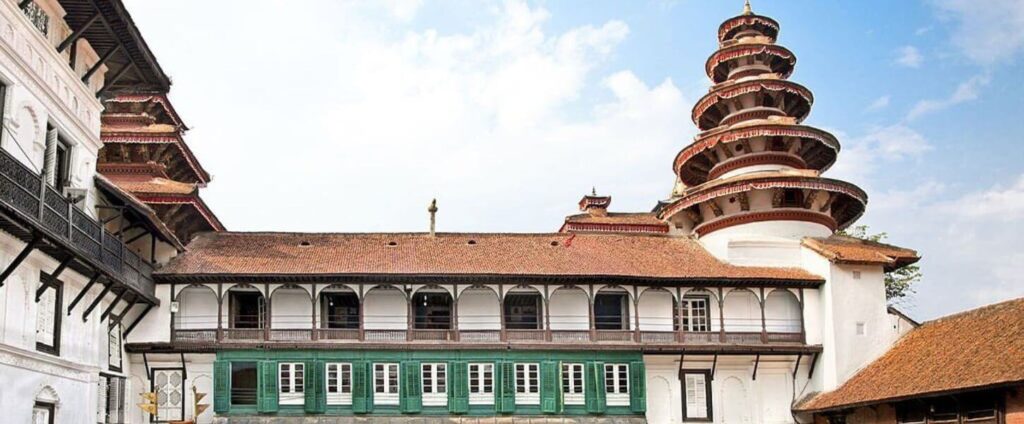
The Kathmandu Durbar Square’s countless structures may easily overwhelm one. A few sites in the Square are the House of the Living Goddess (Kumari Ghar), the fearsome Kal Bhairab, the Red Monkey God, and hundreds of sensual sculptures! The structures in this area, which are the Malla dynasty’s finest works of art, are the products of intense competition between Kathmandu, Patan, and Bhaktapur’s three royal palaces. Different parts of the Valley were given to the Yaksya Malla children.
It was fortunate for Nepalese and today’s tourists that they and their descendants started an artistic arms race to outdo one another in magnificent structures. Kings created everything in an even greater style by copying what their neighbors did. Among the several monuments in the Square are the pagoda-style temple, the shrine of Goddess Taleju (it is said that she played dice with King Jaya Prakash Malla), and a statue of Shiva and Parvati seated side by side.
It is one of the oldest Buddhist Chaityas in the world and is thought to be 25 centuries old. The Great Stupa of Swayambhu symbolizes both Nepal’s beauty and its splendor. It is recognized as a World Heritage Site, demonstrating that it is the hub of devoted worship for the faithful Bajrayan ideology and honors Lord Adi Buddha. It is devoted to the God of the self-originating flame. A sturdy hemisphere of terra-cotta bricks and earth supporting a cornice of copper and gold make up the stupa, the prominent structure. The all-seeing eyes of Lord Buddha are shown on the four-sided base of the spiral, perpetually observing the valley and separating sin from virtue.
The sacred Bishnumati River separates it from Kathmandu City proper, two kilometers away. It is 500 feet above the Valley’s level and is perched on top of a mound. The hill is covered in a mosaic of tiny Chaitya and pagoda temples. Another significant Buddhist temple, Manjushree, is situated on the hind hill. This Buddha in China represents the God of Knowledge.
Even though Bhaktapur is close to the capital, the atmosphere and feeling of history there are so drastically different that it might as well be on another planet. Although satellite dishes are slowly encroaching, not much has changed in this area over the years.
The National Museum of Woodcarving, the Bronze and Brass Museum, and the National Art Gallery are all located in Bhaktapur. Visit the Golden gate, the Palace with fifty-five windows, the Lion gate, and the Picture Gallery. The beautiful Changu Narayan temple, which has been around since the fourth century, is located four kilometers distant. This temple has a lengthy history, but it was constructed in the seventh century, and because it is one of Kathmandu’s least visited, it has a more atmospheric atmosphere.
The mansion of the old Patan Royal Family is located inside the Patan Durbar Square complex, which is located in the heart of Patan, also known as Lalitpur, “the city of arts”. Its three principal courtyards are the palace’s Mul Chowk, Sundari Chowk, and Keshav Narayan Chowk.
The oldest one, Mul Chowk, is in the middle of Patan Square. The western portion of the complex is made up of several different-sized and-styled temples. These include the Golden Temple of Hiranya, the Krishna Temple, and the Bhimsen Temple.
A historic Hindu temple called Changu Narayan Temple is located 15 kilometers from the Kathmandu Valley. The 4th century marks the beginning of the temple’s history. The ancient stone inscription from 464 A.D. and other architectural marvels highlight the Kathmandu Valley’s lengthy history.
Q. What more do I need to know about Kathmandu’s attractions?
In addition to going to the Thamel, consider these excursion suggestions to make the most of your trip:
1. Kathmandu Valley UNESCO Sites Day Tour
2. Nagarkot Sunrise And Bhaktapur Durbar Square UNESCO Tour
3. Everest Base Camp Heli Tour
Q. What tourist destinations are closest to Thamel?
Nearby attractions:
1. Garden of Dreams
2. Market Asan
3. Hanuman Dhoka
Q. What is Kathmandu well-known for?
A historic city known for fusing Buddhist and Hindu culture is Kathmandu. Star attractions of Kathmandu include the Kumari Living Goddess, Swayambhunath Stupa (the Monkey Temple), the Durbar Square, and Boudhanath Stupa. Sadly, Kathmandu is also well-known for a devastating earthquake that struck the city in 2015 and caused damage to several areas of the city.
Q. How safe is Kathmandu?
In general, Kathmandu is a safe city. Although minor crime is more frequent, violent crime is uncommon. But because of the poorly built buildings, the probability of earthquakes in the seismically active nation is significant. Winter and spring also have significant levels of air pollution, frequently dangerous for people with respiratory issues.
Kathmandu is capital city of Nepal is known as city of thousand temples. We have 3 major city incite Kathmandu valley. Among these three city Kathmandu is known as city of thousand temples, Patan is known as city of fine arts and Bhaktapur is known as city of devote. Whole 3 city is known as Kathmandu Valley also known as city of 1000 temples. Among 1000 temples these are major temples also listed in UNESCO world heritage sites.
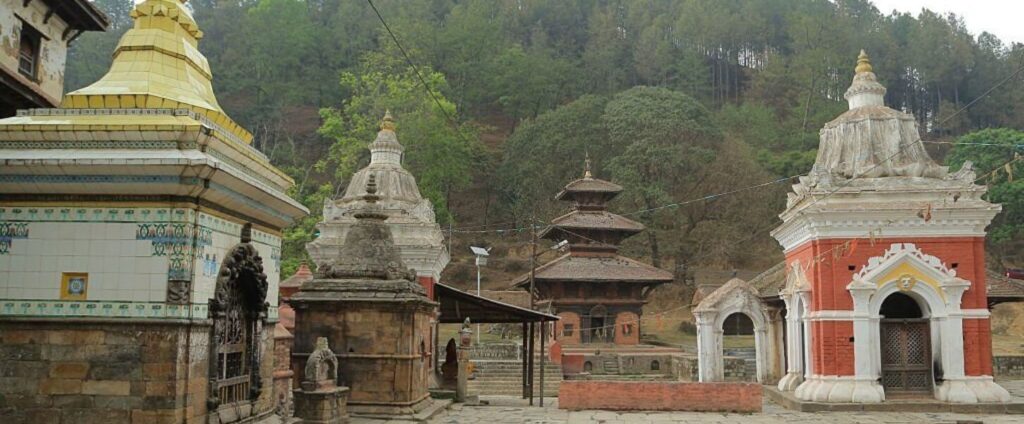
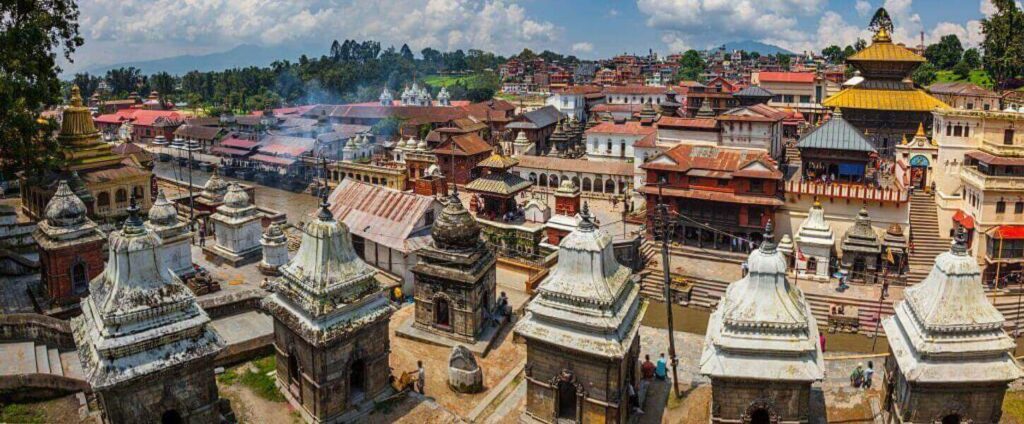
Pashupatinath Temple is a famous and sacred Hindu temple complex that is located on the banks of the Bagmati River, approximately 5 km north-east of Kathmandu in the eastern part of Kathmandu Valley, the capital of Nepal. The temple serves as the seat of Pashupatinath.
This temple complex was inscribed on the UNESCO World Heritage Sites’s list in 1979. This “extensive Hindu temple precinct” is a “sprawling collection of temples, ashrams, images and inscriptions raised over the centuries along the banks of the sacred Bagmati river” and is included as one of the seven monument groups in UNESCO’s designation of Kathmandu Valley as visit here. The temple is dedicated to major Hindu God Shiva, also known as national deity of Nepal.
Kasthamandap Temple was a three-storied public shelter that included a shrine consecrated to Gorakshanath situated at Kathmandu Durbar Square area, Nepal also listed in UNESCO world heritage site’s list in 1979.
Several myths and stories about the date of the construction of the Kasthamandap Temple have been resolved with the recent archaeological findings. The newly discovered objects during the excavation here in the aftermath of the 2015 earthquake have suggested that the Kasthamandap may have been built in the 7th century during the Lichhavi era.
Krishna Temple is the most important temple in Patan Durbar Square, which was listed in UNESCO world heritage sites in 1979. It was built in the local variety of Shikhara style called Granthakuta. The stone carvings along the beam above the first and second-floor pillar are most notable.
The first-floor pillar carvings narrate the events of the Mahabharata, while on the second floor there are visual carvings from Ramayana. Krishna temple was built in 1667AD by King Siddhi Narsingh Malla. It is said that one night the King saw Lord Krishna and his consort Srimati Radha standing in front of the royal palace. He ordered a temple to be built on the same spot.
There are 21 golden pinnacles in the temple. Below the pinnacles are three stories. The first floor holds the main shrine of Lord Krishna with shrines of Radha and Rukmini at each side. The second floor is dedicated to Lord Shiva and the third to Lokeshwor (Avalokiteshvara). The square is crowded with thousands of Hindu Pilgrims and devotees during Krishnastami festival.
Changu Narayan Temple is ancient Hindu temple which is located on a high hilltop that is also known as Changu or Dolagiri. This temple is dedicated to major Hindu God Bishnu, also known as preserver God in Hinduism.
The temple was surrounded by champak tree forest and a small village known as Changu. The temple is located in Changunarayan Municipality of Bhaktapur District, Nepal. This hill is about 9 miles or 16 km east of Kathmandu and a few miles north of Bhaktapur. The Manohara River flows beside the hill. This shrine is dedicated to lord Visnu and held in special reverence by the Hindu people.
This temple is considered to be the oldest temple in the history of Nepal. The Kashmiri king gave his daughter, Champak, in marriage to the prince of Bhaktapur. Changu Narayan Temple is named after her. This temple also listed in UNESCO world heritage sites in October 1979 by UNESCO.
Bhaktapur Durbar Square is another UNESCO world heritage sites which was listed in October 1979 by UNESCO. This place was royal palace of the old Bhaktapur Kingdom until 18th century. Bhaktapur is situated in 1,400 meters (4,600 ft) above sea level. It is a UNESCO World Heritage Site.
The Bhaktapur Durbar Square is located in the current town of Bhaktapur, also known as Khwopa, which lies 13 km east of Kathmandu. While the complex consists of at least four major squares (Durbar Square, Taumadhi Square, Dattatreya Square and Pottery Square), the whole area is informally known as the Bhaktapur Durbar Square and is a highly visited site inside the Kathmandu Valley.
Boudhanath Stupa is a biggest Buddhist stupa (Temple) in Nepal and second biggest Buddhist stupa in Asia. Its located about 11 km (6.8 mi) from the center and northeastern outskirts of Kathmandu, the stupa’s massive mandala makes it one of the largest spherical stupas in Nepal.
The Buddhist stupa of Boudha Stupa dominates the skyline; it is one of the largest unique structure’s stupas in the world. The influx of large populations of refugees from Tibet has seen the construction of over 50 Gompas (Tibetan convent) around Boudha. As of 1979, Boudha Stupa was listed in UNESCO World Heritage Site.
Along with Swayambhunath, it is one of the most popular tourist sites inside the Kathmandu Valley. Boudhanath Stupa is on the ancient trade route from Tibet which enters the Kathmandu Valley by the village of Sankhu in the northeast corner, passes by Boudha Stupa to the ancient and smaller stupa of Cha-bahi named Charumati Stupa (“Little Boudhanath”).
Tibetan merchants have rested and offered prayers here for many centuries. When refugees entered Nepal from Tibet in the 1950s after Tibet and China war, many decided to live around Boudhanath. The Stupa is said to entomb the remains of Kassapa Buddha.
Swayambhunath Stupa, is an ancient religious architecture atop a hill in the Kathmandu Valley, west of Kathmandu city. This Buddhist temple also known as Monkey temple. The Tibetan name for the site means ‘Sublime Trees’, for the many varieties of trees found on the hill.
However, Shing.kun may be a corruption of the local Nepal Bhasa name for the complex, Swayambhu, meaning ‘self-sprung’. For the Buddhist Newars, in whose mythological history and origin myth as well as day-to-day religious practice Swayambhunath occupies a central position, it is probably the most sacred among Buddhist pilgrimage sites.
The complex consists of a Stupa (Buddhist Temple), a variety of shrines and temples, some dating back to the Licchavi period. A Tibetan monastery, museum and library are more recent additions. The stupa has Buddha’s eyes and eyebrows painted on. In between them, the number one (in Devanagari or Nepali script) is painted in the fashion of a nose. There are also shops, restaurants and hostels.
The site has two access points: a long staircase leading directly to the main platform of the temple, which is from the top of the hill to the east; and a car road around the hill from the south leading to the south-west entrance. The first sight on reaching the top of the 365 steeps stairway is the Vajra. We were breathless and sweating as we stumbled up the last steep steps and practically fell upon the biggest vajra (thunderbolt) that I have ever seen.
Behind this Vajra was the vast, round, white dome of the stupa, like a full solid skirt, at the top of which were two giant Buddha eyes wisely looking out over the peaceful valley which was just beginning to come alive. Much of Swayambhunath’s iconography comes from the Vajrayana tradition of Newar Buddhism.
However, the complex is also an important site for Buddhists of many monastry, Chaitya, statue of Buddha. Around big Buddhist stupa we have beautiful Nepali Style or Pegoda style 2 stories temple which is known as Harati Temple, which is protective deity of Children, dedicated to Goddess Harity.
Also offering the worship by Buddhist and Hindu. This is ancient hospital for Children in Kathmandu Valley, Nepal. This Swyambhunath Stupa was listed in UNESCO world heritage sites in October 1979 by UNESCO.
For more information visit our website: www.attractivetravelnepal.com or Email us: info@attractivetravelnepal.com, attractivetravelnepal@gmail.com or Whats App us: +9779851048567