Swayambhunath Stupa UNESCO Tour

Swayambhunath Stupa UNESCO Tour, Swayambhunath, also known as the Monkey Temple and a self-existent flame, is one of Nepal’s top ten heritage monuments.
West of Kathmandu City, in the Kathmandu Valley, is the ancient temple complex known as Swayambhu (also spelled Swayambu or Swoyambhu).
Swayambhunath Stupa is the oldest and most enigmatic of all the holy places in the Kathmandu valley. It is a golden spire sitting atop a conical hill covered in trees. One can see its tall white dome and gleaming golden spire from every angle in the valley.
Mythical History of Swayambhunath Temple
One of Nepal’s most sacred Buddhist stupas is Swayambhu, perched on a hill 3 kilometers to the west of Kathmandu. It is believed that the valley spontaneously evolved more than 2,000 years ago from a primordial lake. There are several temples and monasteries around this stupa, which is the first of its kind in Nepal.
Swayambhu, regarded as a representation of harmony and love, is named after its existence. Dated to 460 A.D., according to some. King Manadeva had erected it, and by the 13th century, it had become a significant Buddhist hub.
Legend has it that a large lake with lotuses that glow like stars in the sky once filled the entire valley where Swayambhunath stood. Then, one day, the God Manjusri saw a Lotus in Swayambhunath and went to see it.
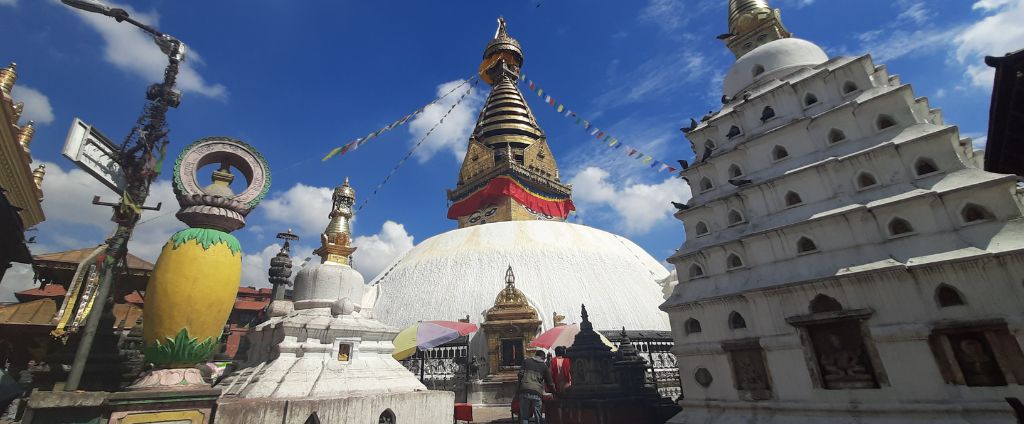
Manjushri cut a deep gorge at Chovar to drain the ancient lake, leaving dry land where modern Kathmandu currently stands because he envisioned the valley as a home for a virtuous community and wanted to make the site accessible to human pilgrims. Consequently, a glowing flower transformed into a stupa, and the sacred lotus became a hill. Indeed, Swayambhunath resembles a magnificent lotus when you view it from the peak.
Swayambhunath’s Diverse Worshippers
Hindus, Vajrayana Buddhists from northern Nepal and Tibet, and Newari Buddhists from central and southern Nepal all gather to worship at Swayambhunath. Every morning before dawn, hundreds of pilgrims climb the hill’s 365 stone steps. Along the way, they pass two stone lions and a golden Vajra (Tibetan: Dorje) guarding the entrance before beginning a series of clockwise circumambulations around the stupa (though Newari Buddhists walk in the opposite, counterclockwise direction).
Symbolism of the Stupa Eyes
Two large eyes peer outward from all four sides of the main stupa, representing divine, all-pervasive vision. Instead of a nose, artists place a symbol resembling the number one in the Nepali script between the eyes, denoting that the Buddhist path serves as the sole route to enlightenment. Furthermore, a third eye sits above each pair, symbolizing inner spiritual awareness. Because tradition holds that the Buddha cares little for flattering prayers, creators omit ears entirely from the iconography.
A UNESCO World Heritage Sanctuary
Reaching the stupa requires climbing 365 steps—a challenging yet rewarding journey that reveals Swayambhunath’s rich history alongside stunning views of the city where Buddhists and Hindus worship throughout the day. Visitors can fully appreciate these vibrant customs in May during Buddha Jayanti, which celebrates Lord Buddha’s birth each year. Watch out for local monkeys; you can feed them, but they will quickly steal all your leftovers! Since the fifth century, the Swayambhunath Stupa has served as a premier Buddhist pilgrimage site, earning official recognition as a UNESCO World Heritage Site. Perched atop the hill, this scenic sanctuary overlooks the entire Kathmandu Valley, offering breathtaking panoramic views and a tranquil escape from the city bustle. Thousands of global travelers recommend Swayambhunath as an absolute must-see destination in Kathmandu.
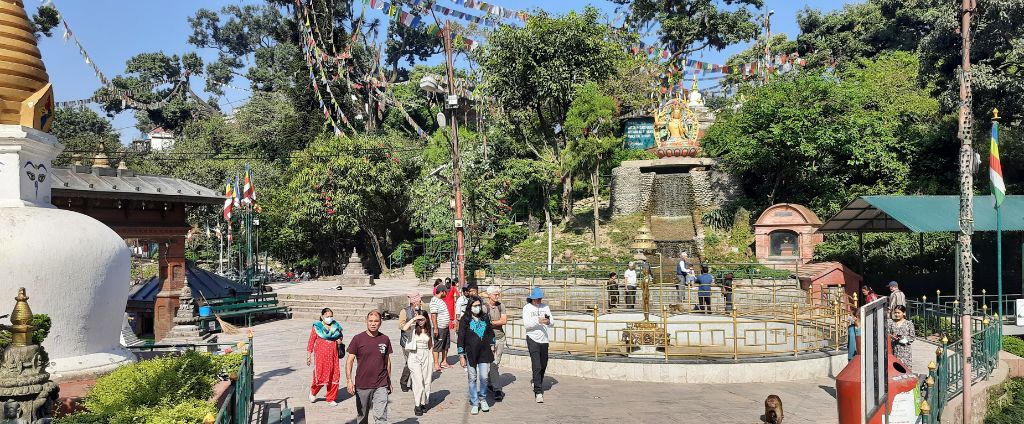
Approximately 7 miles from Tribhuvan International Airport, Swayambhunath may be reached by bus in 30 minutes.
It should come as no surprise that you could spend all day here being seduced by this place’s surreal beauty. From a great distance, one can see the gigantic whitewashed dome with the Buddha’s all-seeing eyes and gilded spire.
But when you are standing right close to the tall stupa, you experience that sense. Watch in awe! Swayambhunath is a box full of marvel to a frequent visitor even as it is a box full of surprises for a new visitor.
Explore The UNESCO World Heritage Site – Swayambhunath Stupa
Buddhist Newars and Tibetan Buddhists revere Swayambhunath Stupa, one of Nepal’s holiest pilgrimage sites.
In the Kathmandu valley, Swayambhunath Stupa is the oldest and most mysterious of all sacred sites. From every angle of the valley, one can see its grand white dome and glistening golden spire.
According to historical documents found on a stone inscription, the stupa was a major Buddhist pilgrimage site by the fifth century A.D. However, it has much older origins, dating to a period long before Buddhism spread throughout the valley.
A collection of local stories from the 15th century, Swayambhu Patan, claims a miraculous lotus that grew out of the lake that previously filled Katmandu Valley and was seeded by a former Buddha.

The Legend and Origin of Swayambhunath
Indeed, people named the location Swayambhuu (“Self-Create” or “Self-Existent”) when a mystical lotus inexplicably began to emit dazzling light. Historically, saints, sages, and gods flocked to the ancient lake to worship this glowing light for its capacity to bring about spiritual enlightenment. Later, Bodhisattva Manjushri experienced a vision of the brilliant Swayambhu light while meditating on Wu Tail Shan. To worship the sacred lotus, Manjushree rode his blue lion across the mountains of Tibet and China. Deeply moved by the radiance of the light, Manjushree reasoned that draining the lake water would make Swayambhu much easier for human pilgrims to reach.
Consequently, in a region known as Chovar, Manjushree carved a deep gorge with a powerful sword, creating Lake Madara. After four days and nights of continuous draining, the floodwaters left the valley where modern-day Kathmandu now sits. Following this transformation, the divine light created the Swayambhunath Stupa, and the sacred lotus transformed into a hill.
Plan Your Visit with Attractive Travels
Attractive Travels proudly features Swayambhunath as one of its most appealing destinations in Nepal. Please feel free to get in touch with us if you intend to visit this famous holy place.
Frequently Asked Questions About Swayambhunath
Which deity is associated with Swayambhu?
The Mahabharata and the Ramayana refer to Vishnu as Swayambhu.
Who built the Swayambhunath Stupa?
Numerous temples and monasteries surround this stupa, which represents the first monument of its kind in Nepal. Swayambhu means “the self-existent one.” Historians believe King Manadeva constructed it in 460 A.D., and by the 13th century, it had evolved into an important Buddhist center.
What is the story behind Swayambhunath?
According to mythology recorded in the Swayambhu Purana, a massive lake originally covered the entire valley until a magical lotus sprouted from its waters. People began using the name Swayambhu (“Self-Created”) for the valley. The name derives from a perpetual, self-existent flame (svayambhu) over which builders later erected a shrine.
Why do people call it the Monkey Temple?
This nickname stems from a family of monkeys inhabiting the northwest corner of the Swayambhunath temple complex for centuries. Legend states that Manjushri created them when he spent time on the hill housing the temples.
What do the eyes on the Swayambhu stupa symbolize?
Enormous pairs of eyes gaze outward from all four sides of the main tower on every Buddhist shrine here. People also call these Buddha Eyes or Wisdom Eyes, representing a Buddha’s all-seeing omniscience.
How old is Swayambhunath?
Dating back over 2,500 years, the famed Swayambhunath Temple—frequently called the Monkey Temple due to troops of playful monkeys running amok—brims with Buddhist and Hindu iconography while offering a breathtaking bird’s-eye view of the city.
What is the original name of Swayambhunath?
People formally name the stupa Swayambhu MahaChaitya. However, historical records show its original name was “Singru-vihara-caitya-bhatjarika.”
Is Swayambhunath a World Heritage Site?
The Monkey Temple, which people also call Swayambhu (the self-existent flame), stands as one of Nepal’s major heritage monuments. In 1979, UNESCO inscribed it as a World Heritage Site, drawing visitors worldwide who seek harmony and calm.
How many steps lead up to Swayambhunath Stupa?
To reach the Swayambhunath Stupa, most visitors climb the 365-step stone staircase, although hikers can alternatively scale the western side of the hill to enjoy stunning panoramic views of the Kathmandu Valley.
Download PDF