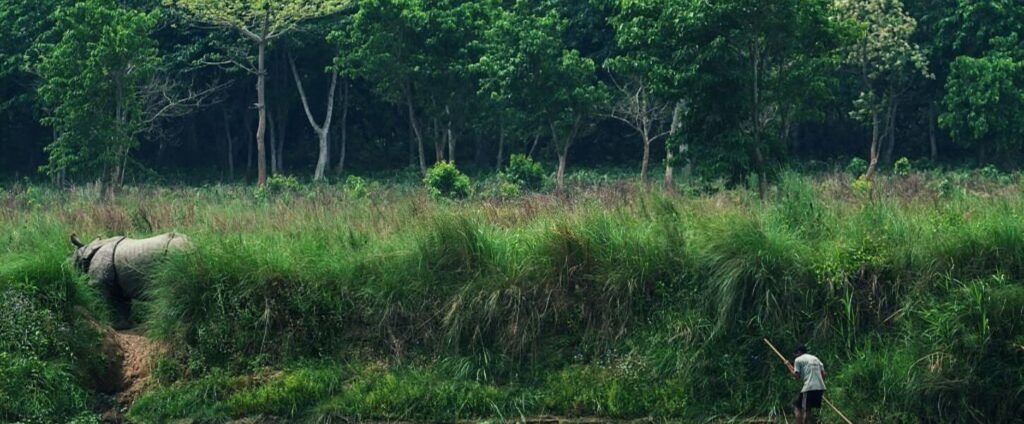
You enter a region that is rarely seen by outsiders when you participate in our guide to Chepang Hill Trek. It is located north of Chitwan National Park in the country’s beautiful central hills. The Chepang Hill Trek is so named because as we go along the hilly terrain, we pass through communities inhabited by the Chepang people. The location is heaven for those who enjoy the outdoors and bird watching. In essence, Nepal is home to about 846 bird species, or 10% of all bird species worldwide. The area is also home to a wide variety of fauna.
Discovering the Chepang people, the local ethnic group, is one of this trek’s key highlights. Their native tongue belongs to the Tibeto-Burman language family. They used to lead a semi-nomadic existence, but in recent generations, they have begun to settle down.
They are now more dependent on farming permanently. The diverse landscape makes farming challenging and forces people to gather food from the outside more frequently. Additionally, the Chepang people have their language and way of life. The trekking route also goes via Newar, Chhetri, and Magar villages, in addition to Chepang.
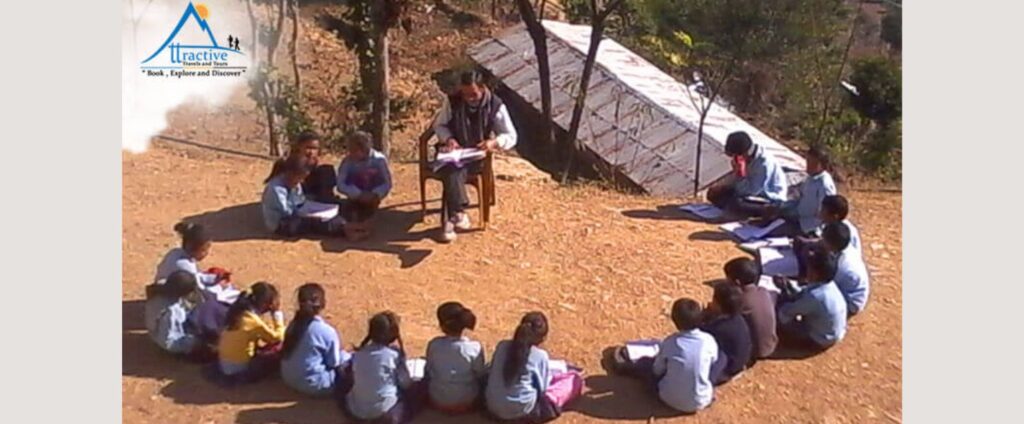
The population of Chepang is dealing with an increasing number of issues, such as malnutrition, illiteracy, and marginalization by the Nepali government. By participating in the guide to Chepang Hill Trek, you will visit some of Nepal’s most remote and distinctive communities and assist the inhabitants in becoming economically self-sufficient.
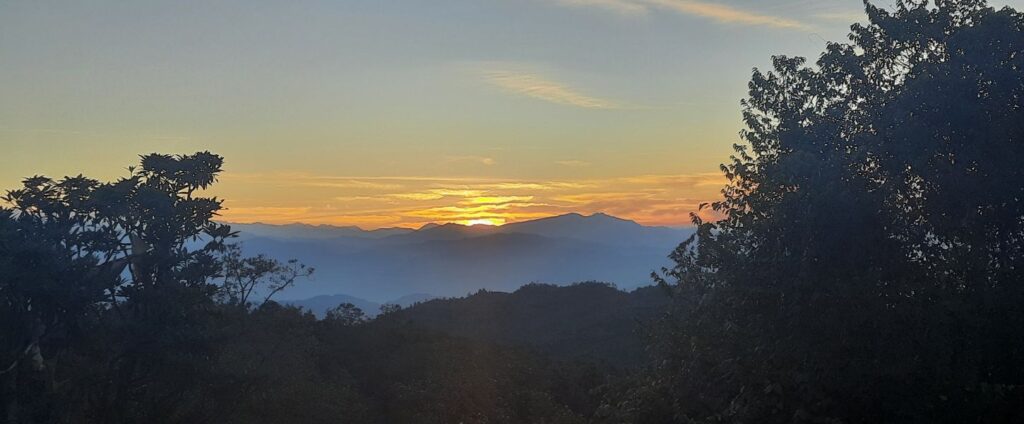
We leave Kathmandu and continue our adventure after a beautiful drive. There aren’t many people on the trail because it is a somewhat “off-the-beaten-path” excursion. You will be made to feel entirely at home during your stay at the homestay. A viewpoint at Siraichuli (1945 meters), from which we can see the Annapurna, Manaslu, Langtang, and Dhaulagiri mountains, can be reached by hiking over the terraced slope.
Then, we make our way down through lush, rainy woods till we get to Shaktikhor, a bustling market that is interesting to explore. The following day, we return to Kathmandu and reflect on our trip with a stereotypical Nepali lunch.
Come along with us on this fantastic cultural hike to discover Chepang culture! The track is ideally close to Chitwan National Park, making it simple to incorporate into a safari excursion.
Trekking is feasible at any time of the year, but the finest seasons are spring (March to May) and fall (September to November). The Chepang Hill Trek demands moderate fitness and acclimatization to prevent extreme mountain sickness. Please don’t hesitate to get in touch with Attractive Nepal for further information .
The cost of lodging is included in each of our packages. The predetermined itinerary consists of this lodging. We will book you into a 2-3 Star hotel while you are in Kathmandu. Our guides will choose the ideal lodge for you to stay in throughout the walk based on their expertise and room availability.
Every type of lodging will be on a twin-sharing basis. Showers and restrooms will be shared in the mountain. You would have to share a room with a same-sex trekker from another group during the busiest trekking season.
There is a broad range of food available in Nepal, and it is simple to meet your demands. If you let us know ahead of time if you are vegetarian, vegan, gluten-free, or lactose-free, we can make accommodations.
Breakfast, lunch, and dinner are all included in the hike. We will provide you with your breakfast while you are a guest at the hotel in Kathmandu. Dinner and lunch must be paid for separately. We will prepare your meals while you are camping. We can choose typical Nepali, continental, Italian, Tibetan, and Indian fare at tea houses during teahouse treks. After our trek, we will celebrate and eat a typical Nepalese lunch before leaving for Thamel.
A guide will lead the walk with official credentials. Our guides are genuine about the trekking business and have extensive trail expertise. Your trekking trip in Nepal will be one you’ll never forget, thanks to the dedication of our guides and porters. Our guides will answer any questions you may have while on your walk.
Our top priority is keeping you secure. More than six individuals will require two available guides. On teahouse treks, every two trekkers will be accompanied by a porter. We will need extra porters for camping trips to transport the food, kitchen supplies, tents, etc.
We must give our bodies enough time to adjust to the altitude because many of our hikes take us far into the Himalayas. Acclimatization days are planned into the schedule of our hikes. To avoid altitude sickness, it is best to move slowly. Depending on the hike, a certain level of fitness is required.
Expect to walk for an average of 5 to 6 hours each day while participating in the trial. Those of moderate fitness may often complete the treks. Personal commitment and a cheerful mood are more crucial than experience or fitness for completing and enjoying the walk.
Before embarking on a hike, we firmly advise getting travel insurance. Although we try our best to look after you, unexpected things sometimes happen. It is best to get insurance if a medical emergency necessitates a helicopter evacuation. You must purchase medical insurance in your home country since you cannot do so in Nepal. Make sure your insurance covers mishaps overseas and at altitude.
Spring (March to May) and Autumn are the busiest times to travel in Nepal (September to November). Although they are a little busier than the off-season, these seasons offer the most beautiful scenery and clearest skies.
Trekking is possible in the Winter (December to February). However, the weather will be chilly. Trekking is also possible from June to August, when there is a significant possibility of rain and views that are likely to be hidden by clouds.
If you ever wish to visit this historical and fantastic place, don’t hesitate to contact us, as we provide an itinerary of 10 days at Chepang Hill Trek. You can check our post for more details and inside into the guide to Chepang Hill Trek .
Q: In what part of the world is Siraichuli Hill located?
The Kaule Village Development Committee in Chitwan District, Narayani Zone of Nepal, is home to Siraichuli, the highest hill peak in the district.
Q: What is the height of the Siraichuli hill?
Siraichuli is located at an elevation of 1945 meters and offers views of the Terai region of southern Nepal and mountains like Gausankhar, Dhaulagiri, Langtang, Rolwaling, and Manaslu.
When one thinks about Nepal, one envisions a stunning tapestry of Hindu temples and Buddhist monasteries, the massive, snow-capped Himalayas, lush forests, and clear rivers. Nepal may be little in comparison to India and China, but that does not mean it should be disregarded. Offering a lot of adventure activities in Nepal. The state has more to offer than just breathtaking scenery; Nepal is unrivalled if you’re looking for adventure. The combination of limitless fun and thrill offered by the adventurous sports accessible here doubles the area’s majestic beauty.
As you engage in some of Nepal’s most engaging recreational activities, let your heart race with excitement. If you participate in one of these sports, you will get a strong adrenaline surge. So, leave your hotel beds and do something you will never forget. Some of these things you could have already completed in other nations, but the real significance resides in completing them in Nepal, which is home to the breathtaking Himalayas. Here is a comprehensive collection of these incredible thrillers.
When you think of adventure in Nepal, this comes to mind immediately. That is reasonable, given that this is where you have the best chance to learn about the Himalayas. Nepal is a wonderland for trekkers worldwide since it is home to eight of the ten highest peaks in the world. Every year, about 20,000 trekkers travel to Nepal for thrill and adventure.
The geography of the Himalayas offers some of the most beautiful trekking trails. It is understandable why Nepal is at the top of the list for hikers worldwide. As you set out on your wonderful tour, you will be in awe of the Himalayan ranges’ majesty. You will also be amazed by the primitive way of life of these mountain people.
In terms of whitewater rafting, one of the best destinations in the world is Nepal. As you engage in one of the most thrilling river rafting and kayaking adventures here, splash in the cool waters. The rush of excitement peaks as you row along serpentine routes surrounded by rocks and boulders.
The majority of the rivers in this area flow down from the Himalayan mountains, which are covered in snow. Your river rafting adventure is even more picturesque because of the emerald forests and clear skies. Watersports enthusiasts, you must not miss this; the thrill is out of this world.
Nepal’s best rafting spots include:
1. River Seti
2. River Trishuli
3. River Sun Koshi
4. River Karnali.
Do you want to glide high in the clear sky of Nepal, heart racing? It would be best if you do not skip the adventure of paragliding in Nepal. Exhilarating panoramas of villages, monasteries, lakes, verdant jungles, and temples can be seen. Fly alongside eagles, kites, and Himalayan griffins. A recent activity worth mentioning is parahawking. By maintaining a piece of meat on your gloved hands, you can feed the birds while you are in the air.
Best Paragliding Locations in Nepal:
What qualifications are needed to paraglide in Pokhara, Nepal?
There are no particular prerequisites in Pokhara, Nepal if you’re a regular individual wishing to paraglide. But a pilot needs a license and some flying experience to fly for gliding.
Nature lovers, including wildlife enthusiasts, now have more opportunities thanks to Nepal’s rich biodiversity. You can drive a jeep through the deep bush or ride an elephant. Some of the most unusual species in the world can be found in the southern plains of the nation, known as Terai.
You have enough land to explore the country’s natural wildness because natural reserves, national parks, and wildlife sanctuaries cover about 16% of the country’s land area. Elephants, one-horned rhinos, and crocodiles are the endangered animals to look out for in this area. And if you spot the gorgeous Royal Bengal Tiger, consider yourself lucky!
Nepal’s Best Jungle Safaris:
You must participate in canyoning while visiting Nepal. The area’s high altitude and particular topography guarantee a canyoning experience unlike any other in your life. Canyoning is one of the most exhilarating and adventurous adventures on Nepal’s rivers. You will be ecstatic to view the exquisite scenery in the distance as you ascend over the golden rocks. Canyoning is even more enticing by the magnificent waterfalls that cascade into small pools.
Canyoning in Nepal: The Best Places
One of the world’s most exhilarating activities is bungee jumping. Take a free fall off the world’s steepest gorges and have an experience you won’t find anywhere else. One of the top bungee experts in New Zealand created the bungee leap in Nepal. The welcoming and knowledgeable jumpers here guarantee your safe freefall and fantastic adrenaline rush.
In Nepal, there are primarily 3 locations for bungee jumping. Three are located in Kusma, Bhotekoshi, and Pokhara, respectively.
Kusma is the second-highest bungee location in the world among the three in Nepal. The height of Kusma Bungee is 228 metres. Pokhara’s bungee jump is 70 metres high, whereas the Bhotekoshi bungee is 160 metres high.
This adventure sport has grown significantly in popularity in recent years. Rock climbing in Nepal’s mountains is a truly exceptional and thrilling experience. As you ascend the challenging slopes, sweat beads form, but every drop is worth the excitement and adventure.
Several fantastic rock climbing alternatives are available nationwide for amateur, intermediate, and expert climbers. You will adore pushing your limits with these rocks in Nepal. The surrounding, densely vegetated area greets you with open arms as you wound your way to the peak.
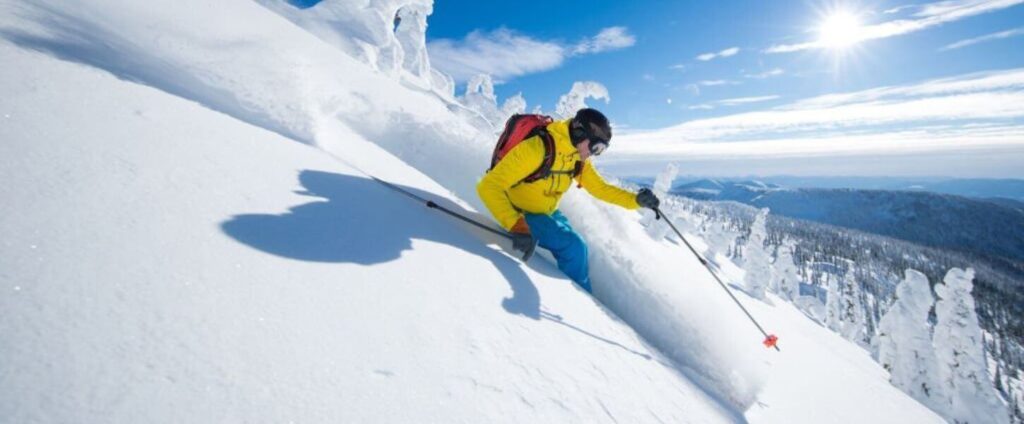
While sliding down the unspoiled, pure slopes, take in a mind-blowing spectacular view of the Nepali mountains. These days, heli-skiing is relatively popular, and you can experience this thrill in Nepal. The distant mountain slopes are even more exciting and enjoyable to explore in the powdery snow. As you enjoy skiing here, the magnificent Nepalese Himalayas let you see their majesty and glory. Ski enthusiasts, this is the perfect place to test your abilities!
Best Skiing Locations in Nepal:
Buckle up because Nepal offers some of the most exhilarating zip lines to experience. You will have minutes of intense thrill and adventure thanks to the steep and lengthy zip lines here. The lush, emerald forests and high mountain peaks that tower over them will astound you. The area’s amazing natural splendour enhances the zip-lining experience.
Another daring sport you can enjoy in Pokhara, Nepal, is Zip Flyer, offered by Highground Nepal, in addition to Bungee Jumping and Swing. Enjoy the 1800-metre-long, 56-degree inclined, steepest, quickest, and longest Zipline in the world.
If you wish to enjoy a zip line while you are in Kathmandu, go to Dhulikhel, which is the closest area. They do offer various packages, like classic, Superman, and pair, and the cost of each varies.
Do you ever have dreams about flying? Take this opportunity to be ready for a skydive in Nepal. It is the most incredible experience to make you feel on top of the world.
Comparatively speaking to other adventurous activities in Nepal, skydiving is one of the more recent adventure sports. The majority of skydiving is done from two locations: Pokhara and Everest. The skydivers take off from either Kala Pathar or Gorak Shep at Everest.
The outdoor activities in Nepal will captivate you. It offers so many activities that you can have endless fun and excitement. The Himalayan nation offers extreme adventure activities because of its breathtaking scenery and mountains.
In addition to the ones mentioned above, Nepal offers a wide range of adventurous activities. Adventure seekers have long been drawn to Nepal. The wonders of the country entice travellers from around the world.
Additionally, for an adventurous experience, if this is your first time in Nepal, I recommend bungee jumping or swinging. Additionally, Pokhara offers ziplining and paragliding for your enjoyment.
You can call us, send a direct WhatsApp message, or email us if you need any help with adventure activities in Nepal.
Q: Can you find adventure in Nepal?
Nepal, surrounded by eight of the highest mountains in the world, is a haven for thrill seekers.
Q: What are the most popular adventure activities in Nepal?
The most popular adventure sports include bungee jumping, swinging, paragliding, and ziplining because they are simple to perform and less expensive than skydiving, trekking, etc.
Q: Which locations provide outdoor adventure activities close to Kathmandu?
Popular locations close to Kathmandu offering outdoor adventure sports, including hiking, biking, ziplining, bungee jumping, swinging, etc., include Nagarkot, Dhulikhel, Chisapani, and Bhotekoshi.
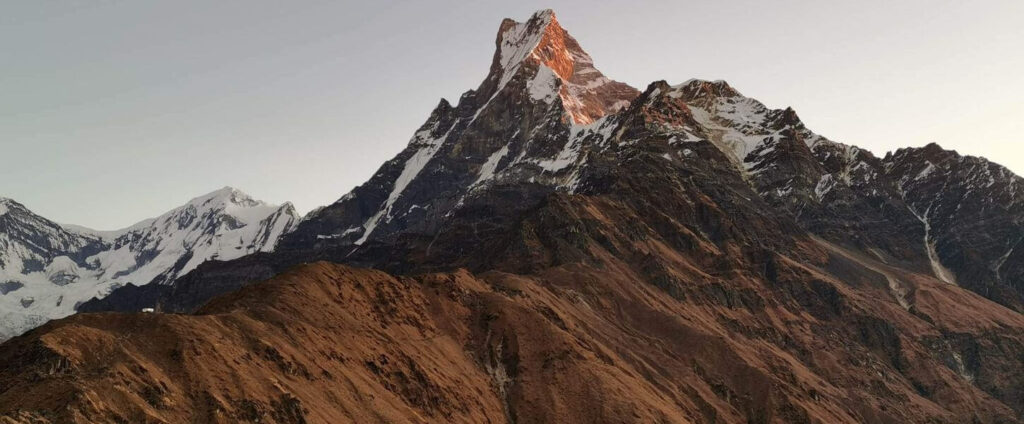
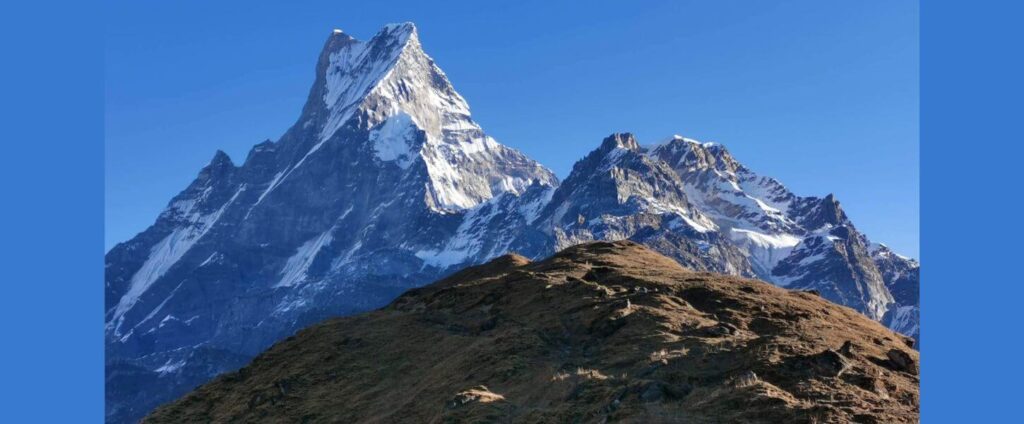
Regarding trekking in the Annapurna Region, the Mardi Himal Trekking is one of the best-kept secrets. You can travel off the beaten path and around the corner of the map from where most people would typically embark on the trip to Annapurna Base Camp. The Mardi Himal Trekking excursion brings you to the Mardi Himal base camp between Machhapuchhre, also known as Fish Tail Mountain, and Mardi Himal.
The views are uncrowded during the Mardi Himal Trekking. Real teahouses, gorgeous rhododendron forests, and the best views of the Annapurna Mountain Range are to be expected. Giants like Mardi Himal, Machhapuchhre, Annapurna South, and Hiunchuli will be beside you. What else do you require?
Machhapuchhre, Fish Tail Mountain, one of the enormous mountains in the Annapurna Massif, keep watching over the Mardi Himal Trekking. Along this journey, several stone homes, charming teahouses, and numerous rock hills may be found.
The trail for this hike may be found right off the main trail to Annapurna Base Camp. Since it differs from other treks in the Annapurna region, like the Annapurna Base Camp Trek and the Annapurna Circuit Trek, it is a well-liked substitute.
You can locate the Mardi Himal Trekking on a side trail leading to the Annapurna Base Camp. It is a little tougher and, for the most part, a little more interesting than most treks in the Annapurna region, but it is also much less crowded. You can get fantastic views of the Annapurna Massif’s lesser-known sides on the Mardi Himal Trekking.
At 4,500 meters, you will arrive at the Mardi Himal Base Camp, which is the destination (17,763 ft). There weren’t a lot of teahouses on this trek at first, but since around 2011, there have been more teahouses along the route from the beginning to the Mardi Himal Base Camp.
There are four distinct seasons in the Annapurna Region and throughout the rest of Nepal. Winter, Spring, Summer, and Autumn. The most popular times to trek this Annapurna classic from March to May and October or November. It must be acknowledged that each trekking season has its unique environment and level of enthusiasm for trekkers.
It might be challenging to complete the Marid Himal Trekking. However, this does not imply that you cannot succeed. As long as you enjoy hiking and prepare for your adventure well in advance, you can make it.
Although the typical Mardi Himal Trekking is not challenging, hikers and trekkers should be in fair physical condition. You are still traveling across Nepal’s Himalayas, after all. Continue reading if you want to learn more about the physical requirements for trekking in Nepal and how you might improve your fitness level.
It can be challenging to select an appropriate Mardi Himal Trekking. You want to spend as much time for Mardi Himal as possible if you want to do it well. You also wish to spend some time in Pokhara because traveling from Kathmandu to Pokhara is frequently included. The village is too charming to pass up. In addition, it will take quite an amount of driving to get there, so you might as well get a little exercise.
The ideal itinerary for 12-day Mardi Himal Trek is one from Attractive Travel Nepal. According to our trekking experts, this schedule is the best choice for a fruitful Mardi Himal trip.
The best friend you can have in the mountains is your equipment. In essence, your gear is essential wherever you are going. The right equipment might be the difference between life and death in terrible situations. A good set of gear can make the difference between a good time and a bad one in every situation.
You have your flights booked, your guide in Nepal is waiting for you, and now you show up with a backpack that is too heavy, a jacket that is too thin, and shoes that are almost certainly going to cause blisters. How wasteful. Make the most of your vacation to Mardi Himal Base Camp by packing the appropriate supplies.
We’ve provided you with a basic, thorough packing list below that is appropriate for any hike in Nepal, along with the Mardi Himal Trekking:
– Duffel Bag
– Rucksack with Rain Cove Daypack
– Hiking Boots
– Sandals or Shoes
– Hiking Socks
– Trekking Poles
– Inner Socks
– Thermal Baselayer
– T-Shirts
– Fleece Pullover or Jacket
– Light Weight Thermal Tops
– Waterproof Jacket
– Sports Bra for Her
– Hiking Shorts
– Hiking Pants
– Waterproof Pants
Preparing your legs for greater elevations won’t be easy if you reside somewhere other than the Himalayas. The Mardi Himal Walk is fortunate because it is not a high-altitude trek and is not as long as some other treks in Nepal. Preparations for the Mardi Himal Trekking are not too difficult.
Practice is a good way to get the hang of what you do. Climbing is the best climbing exercise. We recognize that you appreciate walking since you are interested in a multi-day trekking adventure. Awesome, keep doing it.
The time has come to see them more frequently if you are fortunate enough to live in an area surrounded by hills or even mountains. When? If you are unfamiliar with this, we advise starting your trek a year in advance and committing to a seven-day, 60-minute ascent. After around three weeks, after you have the hang of it, you will have the perfect chance to strengthen your power.
Since Kathmandu is where most international visitors to Nepal arrive, they are more inclined to hike outside of the Annapurna region. The first challenge to trekking in the Annapurna region is this.
To reach Pokhara, one must physically go there. It is standard practice for all hiking companies to provide transportation to and from Pokhara to Kathmandu. Some travel by bus, while others fly. A schedule often includes transportation from Pokhara to Besisahar and hotel accommodations in Pokhara. Below you will find a list of some expenses.
Even though there is no entrance cost, permits must still be purchased. It is hard to climb in the Nepal Himalayas without them. You need two different types of permits for the Mardi Himal Trekking:
1. TIMS: Trekkers Information Management System
Every trekker who wants to go on a trek in Nepal needs to obtain this permit. All trekking routes, from the trek to Poon Hill to Everest Base Camp, require it. Each person pays NRS 2000 for this. This is around 17 USD or 15 EUR.
2. ACAP: Annapurna Conservation Area Permit
Because you will be entering the Annapurna Conservation Area, you will need permission. All permissions are arranged by your hiking company. The Mardi Himal Base Camp Trek costs approximately USD 850 or EUR 700.
We place the highest priority on safety. As a result, whenever it comes to maintaining the cost of our climbs and treks cheap, this is one area where we do not make any exceptions. Trekking firms have been chosen based on their technical proficiency, demonstrated safety performance, perfect judgment, amiable manner, and capacity to offer helpful and knowledgeable directions. Additionally, they are highly competent in first aid and personal safety gear. First aid supplies are supplied on all led climbs and treks in the Annapurna Region.
When there are splits in the trail, signs indicate the appropriate directions. The track is marked with white and blue stripes. It’s simple to find lodging; show up at a guest house and inquire about availability. Although the high altitude, erratic weather, and steep ascents and descents may make this walk difficult for beginner hikers, we nevertheless advise joining a tour.
From Kathmandu to Mardi Himal, hiking excursions are available, including lodging, transportation, permits, guides, full board, etc. If you’re seeking a stress-free hiking vacation, it’s a brilliant option.
One can hire a guide, a porter, or both if you don’t want to hike with a group. The standard day rate for guides, including meals and lodging, is USD 25. One guide can be distributed among several people. Porters are paid $20 USD daily, which covers their lodging and meals. If you don’t overpack, you can hire a single porter to carry up to 25 kg for two trekkers.
Tips for Saving Money on the Trek:
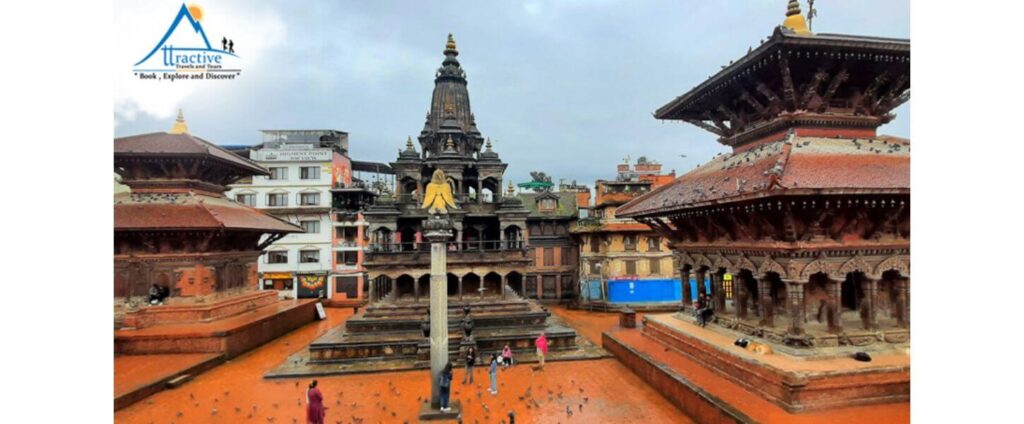
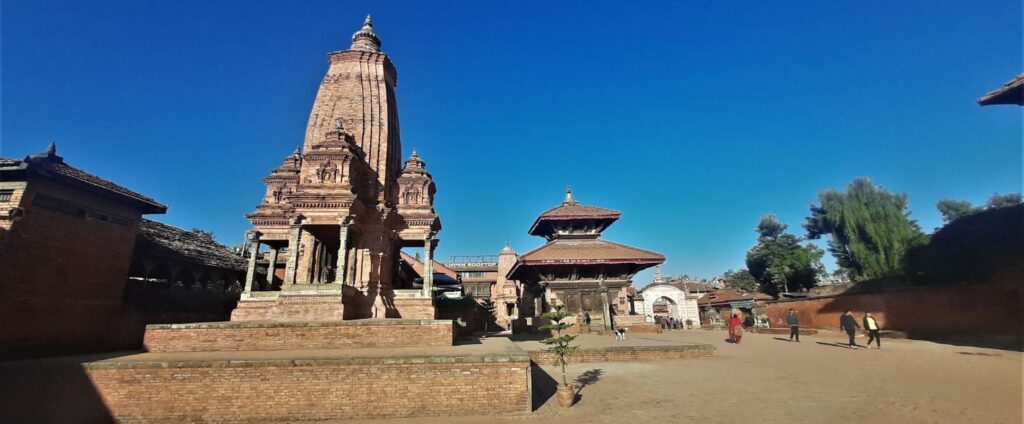
The city, also known as “Bhaktapur Durbar Square,” is 15 kilometers away from Kathmandu and is home to several instances of sculptures, woodcarving, and enormous pagoda temples dedicated to various gods and goddesses.
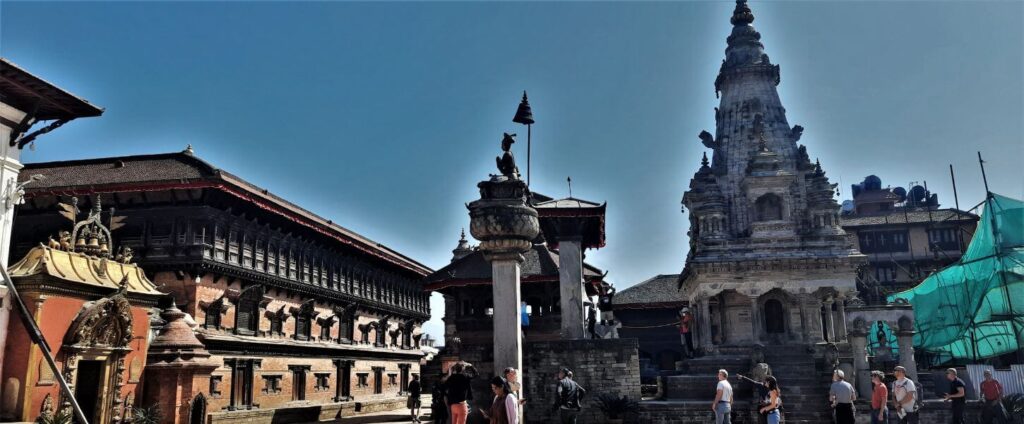
It is a collection of the pagoda- and shikhara-style temples centered on a brick and wood palace with fifty-five windows. The area, which showcases Nepal’s old arts, is one of the Valley’s most endearing architectural showpieces.
The guardian deities peering out from their sanctuaries, the golden shrines of kings sitting atop stone monoliths, and the wood carvings found on struts, lintels, uprights, tympanums, doorways, and windows all seem to compose a well-orchestrated symphony. The two main traditional businesses there are weaving and pottery.
Bhaktapur Durbar square: The most significant of all the tourist attractions at Bhaktapur, Bhaktapur Durbar Square is a well-known tourist hotspot for both domestic and foreign visitors. Newari call this region “Layaku.”
This city’s character is carried by ancient temples and shrines, sculptures, and historical heritage monuments built over various times. Ancient Nepali art highlights include the golden gate, the 55 Window Temple, the Bhupatindara Malla Statue, the Museum, and the Krishna Temple.
You may see the Big Bell, Dog Barking Bell, Siddhilaxmi Temple, Taleju Bhagawati Temple, and more in this location. The Durbar square serves as a gathering place for locals to unwind after a long day, roam around, and have fun.
It is simple to go to this location from various locations in Bhaktapur. Visitors from outside the country must pay a fee to enter this tourist attraction.
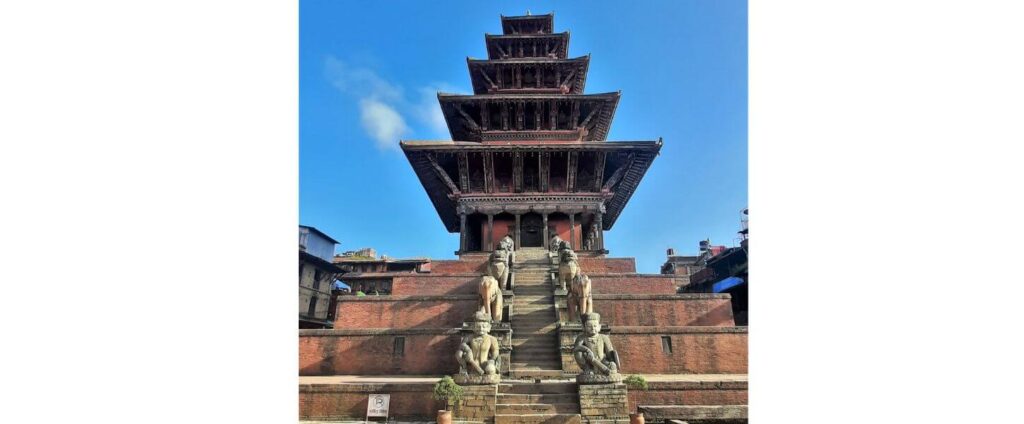
A brick-paved path leads to Taumadhi Square, located east of Durbar Square. Here, a five-story plinth supports the five-roofed Nyatapol temple erected in 1702 and sweeps beautifully into the sky. Stone statues of gods and fantastical animals line the stairway to the temple.
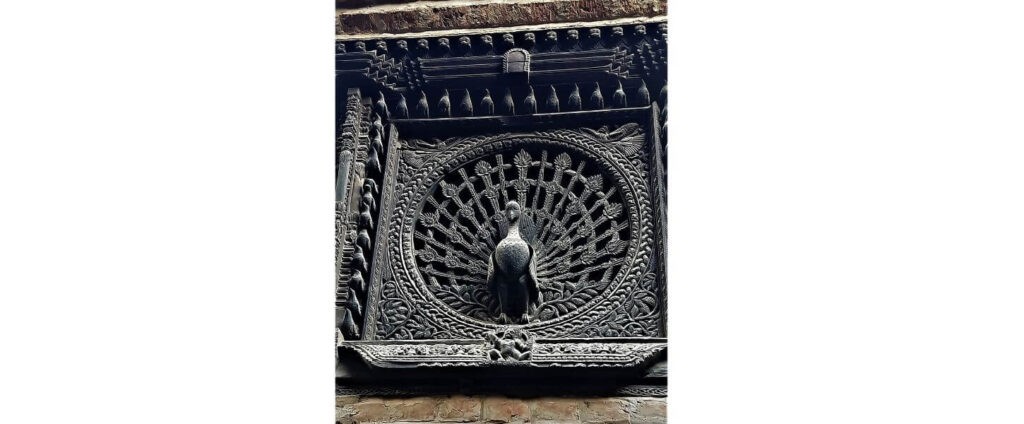
Tachapal Square, also known as Dattatreya, is located at the center of a network of streets dotted with elaborately decorated homes. It has an alluring atmosphere. It serves as the original center of Bhaktapur and the center of uptown. A Hindu monastery in this area called Math houses the Peacock Window, built into the wall.
According to legend, the Golden Gate is the world’s most exquisite and intricately sculpted specimen. The Hindu deity Kali and Garuda, a mythological griffin, are depicted atop the door, and two celestial nymphs are also present. It is decorated with intricately detailed monsters and other mythical Hindu creatures.
The Golden Gate is “the most magnificent work of art in the entire Kingdom; it is situated like a diamond, flashing many facets in the handsome setting of its surrounds,” according to Percy Brown, a renowned English art critic, and historian. The gate, which King Ranjit Malla built, leads to the palace’s main courtyard and its fifty-five windowed structure.
Bolachhen, commonly known as Potter’s Square, is located two minutes walk south of Durbar Square. Here, you may watch potters sculpt wet clay into wide pottery varieties. It contains a display of recently made pottery that has been put outside to dry.
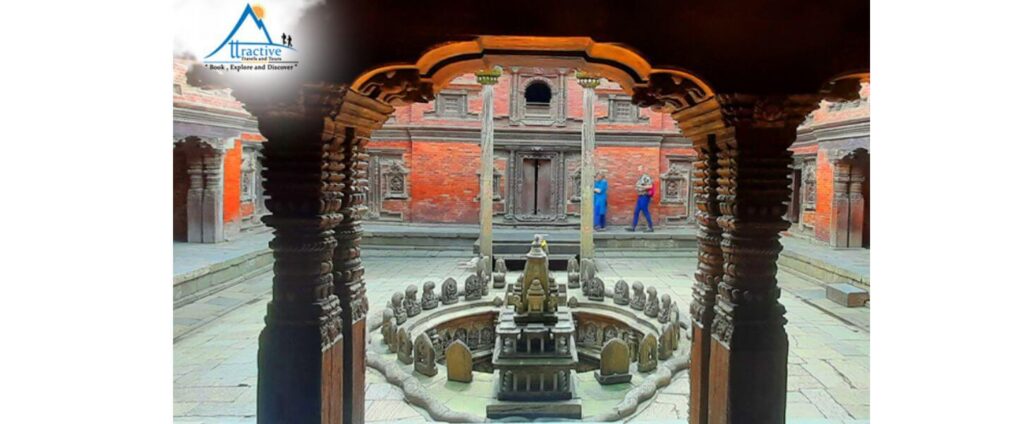
Ta-Pukhu, which translates to “great pond,” is the more popular name for Siddha Pukhu, a pond from the Lichhavi era (350-750 AD). It is a serene area of the city where you may watch the fish and enjoy the stone statues of various Hindu and Buddhist gods while letting your tensions melt away.
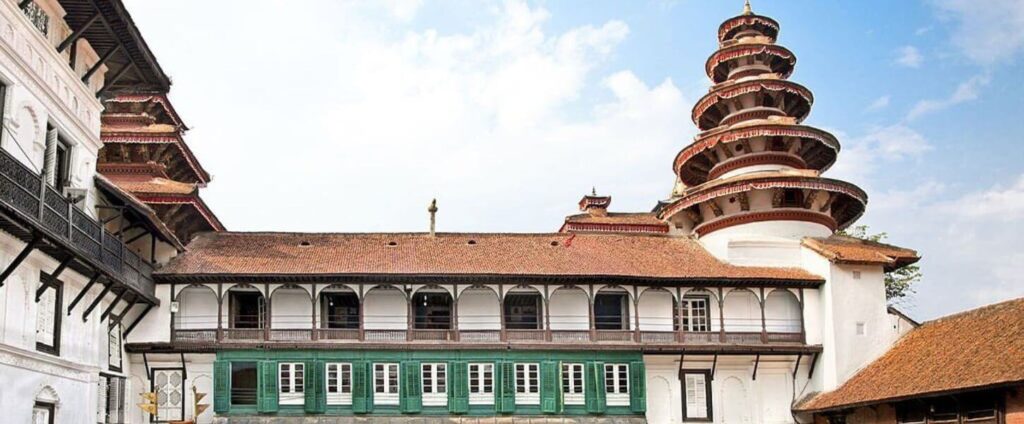
One of the most important works of art in Bhaktapur Durbar Square is the 55 Windows Palace. You can find a lovely setting and exquisitely carved sculptural patterns on windows and doors in the three-story castle. In the 17th century, King Bhupaindra Malla constructed the palace. Its golden gate and a few nearby temples are renowned worldwide as a decorative element of Bhaktapur.
A Five-Storied Temple Nyatapol, Nepal’s tallest and most spectacular pagoda-styled temple, is located at Bhaktapur Municipality’s word number 11. This stunning temple, constructed of wood and clay bricks, is one of Nepal’s greatest architectural achievements. You can find god’s idol inside the temple. The manifestation of wealth, Siddhilaxmi, has been established.
King Bhupatindra Malla constructed this enormous temple in the 16th century, and it is reported that it withstood the devastation of the devastating earthquake in 1933 (except for some minimal injuries to the ceiling of the fifth floor). The follower claimed that the King had laboriously transported bricks for the temple’s building.
The temple’s struts, doors, and windows are decorated with artistically carved divine figures telling divine tales. According to popular belief, the elephant standing over the strong guy in the front is 10 times more powerful than the latter. Thus that is where the deduction is made. As a result, the temple abundantly displays the artistic history of Newar artisans.
Built in the 17th century, this Sikhara-style temple honors the tantric goddess Siddhi Lakshmi. The entrance to this temple is guarded by statues of numerous animals, including camels, rhinos, horses, and even mythological creatures.
On either side of this gate are two stunning stone statues of Hindu deities. According to legend, the artisans who created this had their hands severed as soon as he finished them. An envious Bhadgaon King accomplished this so the artist could stop creating similar works of art.
The National Art Museum, which has a fantastic collection of Medieval and Licchvai arts, is housed in this palace that King Bhupatindra Malla erected in the 17th century. The statues of two lions standing guard at this palace’s entrance gave it its name. Two enormous statues of the Hindu deity Narsimha are also present.
Located in Dattararya in Bhaktapur, The Peacock Window is a well-known tourist attraction. The monarch Yaksha Malla constructed it in the 15th century and has a lovely creative design. Near the main Dattatraya temple, on the second floor of the Pujari shrine, is where you’ll find the Peacock Window.
Among the several shrines in Bhaktapur, it is the biggest. There once resided soldiers and royal officials who were connected to King Haksha. This ancient temple features a variety of artistic shapes. The primary highlight of this structure is the uniquely creative design on almost every window and door. The carpenters who worked on constructing this shrine may have competed with one another.
The building’s whole woodwork is from the fifteenth century. The shrine’s bricks were replaced after the earthquake destroyed the originals. The peacock is a stunning and untamed bird. Buddhists revere Abhitav Buddha, while Hindus worship the peacock as the representative of God Kumar.
Peacocks dance so beautifully that anyone who watches them will have a pleasant and beneficial day. That is why a little window may have been constructed under Yaksha Malla’s rule so that time would favor the town’s residents. The public can view the old artwork and handicrafts in this building up close for a set admission cost. On Tuesdays and federal holidays, the museum is still closed.
The Vatsala Devi Temple is situated at the front of the palace, near the king’s monument, and close to the Taleju Bell. Like the Krishna temple in Patan, this Shikhara-style temple is entirely made of sandstone and rests on a three-stage plinth. It is devoted to the goddess Vatsala Devi, a manifestation of Durga.
King Jitamitra Malla first erected the shrine in 1696. However, the visible building was rebuilt by King Bhupatindra Malla and dates to the late 17th or early 18th century. Dhunge Dhara, a water source, and the Chayslin Mandap are behind the temple. It was most well-known for its silver bell, which locals called “the bell of barking dogs” because when rung, the dogs nearby cried and screamed.
King Ranjit Malla hung the enormous bell in 1737 AD to announce curfews. Every morning, when worshiping the goddess Taleju, it was rung. The 2015 Gorkha earthquake destroyed the Temple, but the bell was unharmed.
The temple dates back to the 17th century and is very appealing. You can see the entire durbar area, the rest house, and the Vatsala Durga Temple from its eastern pedestal. At the same time, you can see all of the Char Dham temples from the western or front pedestal of the temple.
In total, the temple has five pinnacles, including four subpinnacles. Architecturally, they also all rotate in four different directions. Despite this, it looks magnificent with the Lord Shiva statues there.
The stone pillars’ artistic carvings also appear to enchant onlookers. This temple was built by King Bhupatindra Malla, the most active ruler of the Malla period.
Q: What makes Bhaktapur Durbar Square so well-known?
The city’s central center, Bhaktapur Durbar Square, is home to various terracotta, stone, and metal sculptures, and wood and stone carvings. Everything about this place is astounding.
Q: When and by whom was Bhaktapur Durbar Square created?
This is the primary building that dominates Durbar Square as a whole—built in the fifteenth century AD, this spectacular structure. King Bhupatindra Malla is kneeling in devotion to God while seated atop a large column.
Q: What time of year is ideal for a trip to Bhaktapur?
Autumn (October-November)
The monsoon retreat brings in the best time of year to travel to Bhaktapur, with cold, crisp temperatures and a clear, perfect sky that offers stunning visitors to the entire city.
Q: What is Bhaktapur’s history?
In the 12th century, King Anand Dev Malla built the city. Until the 15th century AD, Bhaktapur served as the Greater Malla Kingdom’s administrative center in the Kathmandu Valley. The then-Malla monarchs erected many of Bhaktapur’s most important monuments.
Q: What is Nepal’s largest durbar square?
Bhaktapur Durbar Square
Between Kathmandu and Patan, Bhaktapur Durbar Square does have the best durbar square. Having centuries-old temples and loving the fine woodworking elements of temples. Bhaktapur has very polite residents and is quite clean. If this is your first time, remember to visit durbar square.
Take a leisurely hiking journey through Nepal’s landscape and culture to experience the breathtaking Nagarkot sunrise.
Watch the far-off Himalayas illuminated by the early morning sun, then climb to Changu Narayan, a UNESCO World Heritage Site. As you travel, stop at tiny eateries for breakfast and lunch to taste the local culture as you pass through the Brahmin, Tamang, and Newari communities.
For those who are enthusiastic, energetic, and health-conscious, Nagarkot is an excellent destination. It is the place to enjoy the Himalayan panoramas, weather permitting, as it has several fantastic hiking trails and good nature hikes.
Nagarkot sunrise is a magnificent experience because the morning dawn transforms the colors of the snow-capped Himalayas.
Nagarkot is a peaceful, unhurried retreat from the bustling metropolis of Kathmandu. It is a perfect place to unwind and recharge after the chaos of Kathmandu with delectable meals and leisurely exploring.
You may go on hikes in the Nagarkot region, taking you through Nepal’s stunningly green countryside with stunning mountain views, serene pine woods, and peaceful villages.
The hill town of Nagarkot is well known for its panoramic sunrise and sunset views. Many tourists get up early and go for Nagarkot sunrise trekking to view the magnificent dawn, majesty, and glory of the Himalayas.
One of the most popular tourist destinations, it offers breathtaking views of the High Himalayan Ranges, sunrise, and sunset, as well as breathtaking vistas of picturesque landscapes and hills covered with big cities.
Many tourists prefer coming to Nagarkot in the spring when the surrounding valleys burst into a vibrant rainbow of flower colors. Against the calm backdrop of the snow-covered mountains, the blooms are stunning.
Nagarkot Sunrise and Sunset Views of the Himalayas in eastern Nepal include Mount Everest, the Langtang Range, Ganesh Himal, Ghaurisankar, Rolwaling Himal, and other snow-covered mountain ranges. Additionally, Nagarkot provides a birds-eye overview of the Kathmandu Valley.
Since it is only 17 miles (28 kilometers) from the heart of the city of Kathmandu, the hilltop town of Nagarkot is a well-liked short-getaway destination. The quickest and easiest way to go is via private transfer. Which takes you from the Kathmandu Valley through the foothills of the Himalayas.
The drive to Nagarkot is safe as the road passes through several villages. The bus option is less expensive and takes about one and a half hours.
Alternatively, you can hike one of Nepal’s most well-liked short hikes from the outskirts of Kathmandu, arriving at Nagarkot in about 5 hours. Nagarkot is one of Nepal’s most well-liked short treks and is suitable for hikers of all levels, despite some steep areas.
While traveling through forests of oak, pine, and rhododendron, you’ll see the Kathmandu Valley and the snow-capped Himalayan peaks.
For those with a tight schedule who yet want to experience the thrill of hiking and the splendor of the Himalayas, Nagarkot Day Hike is appropriate.
For outdoor enthusiasts, it is a fantastic location since it offers a variety of activities, including trekking to Nagarkot, nature walks, paragliding, village sightseeing, and hiking tours.
The Nagarkot hike is a fantastic adventure that takes you through a thick pine forest to a view tower from which you can get a panoramic view of the magnificent Himalayan Ranges and the Kathmandu valley.
With our Nagarkot Hike Tour, you may get away from the bustling Kathmandu Valley and into Nagarkot’s peaceful, tranquil setting. This hilltop is the perfect vacation spot in Nepal because it is a place for relaxation and replenishment.
Nagarkot ranks in the top 5 of Nepal’s best dawn viewing destinations. Most passengers take the Nagarkot Sunrise Tour in the morning to take in the breathtaking views of the sunrise and the surrounding snow-capped mountains.
Day 1: Take a drive to Nagarkot and hike to the Changu Narayan Temple, then take a drive to Kathmandu
Since you will visualize the sunrise over the Himalayas from Nagarkot View Point, the Nagarkot Sunrise hike begins at around 4 am from your hotel in Kathmandu. The drive there takes about an hour and a half. Once we arrive, we will view the sunrise view before serving breakfast at the hotel in Nagarkot.
We hike from Changu Narayan Temple, which takes about 3–4 hours. To Changu Narayan Temple, visit the temple, which is a part of Nepal’s UNESCO Cultural Heritage, and then take the bus back to our accommodation in Kathmandu.
Paragliding from Nagarkot is a fantastic experience that ranges from adrenaline-pumping twists. It turns to a truly refreshing experience floating above the stunning wilderness. The scenic views of the Himalayas, forests, beautiful green valleys, and Mongolian villages.
It is accompanied by lovely hills and mountains and is away from the congested area of the city.
Paragliding in Nagarkot delivers a classic surge of adrenaline. Vistas of Everest amid the snow-capped Himalayas and valleys outside of the crowded urban area.
Lapsiphedi, which is 1,905 meters above sea level, serves as the takeoff point for paragliding flights across the Annapurna, Manaslu, Ganesh Himal, Langtang, and Jugal mountain ranges.
Some of the frequently asked questions about Nagarkot Sunrise are listed below.
The earliest name of Nagarkot is Kangra. Kangra is a town in western Himachal Pradesh, northwest India, near the Beas River and the southernmost tip of the Himalayan foothills. At an elevation of 2,409 feet (734 meters), the village is situated along a rail line just south-southwest of Dharmshala.
This mountain range receives a lot of winter snow and is another well-liked destination for snow activities. A great place to see unrivaled sunrise and sunset views is Nagarkot.
The spring months of March and April and the early winter months of October and November are the ideal times to visit Nagarkot. In the spring, the weather is good, and the hills are stunning since the brightest flowers are in full bloom. These months are ideal for outdoor activities like hiking and paragliding.
For seeing the Himalayas, Nagarkot is the perfect destination. Nagarkot is a fascinating place that is well worth visiting. It also provides a variety of adventurous activities. It is a well-known tourist destination in Nepal and receives a lot of visitors.
Yes, you can see Mount Everest from Nagarkot. There are spectacular sunrise views of the Himalayas, including Mount Everest and other peaks in eastern Nepal’s Himalayas. Besides providing a birds-eye view of Kathmandu, Nagarkot allows visitors to admire the valley from a height.
Nagarkot provides views of 8 of Nepal’s 13 Himalayan mountain peaks. These consist of the Numbur , the Mahalangur (Everest Range), the Langtang , the Jugal , the Ganesh Himal , and the Annapurna and the Manaslu Range. The following are some activities to do in Nagarkot:
On the Sunrise and Sunset website, you can view sunrise and sunset time at Nagarkot for the entire month.
Nagarkot is situated at the height of 2174 meters. It offers a panoramic view of Kathmandu city, encompassing Shivapuri National Park and various mountains, including Mount Everest, due to its altitude.
Our staff at Attractive Travels has the expertise to plan an unforgettable vacation to Nepal, Bhutan, or Tibet in the Himalayan region, home of Mt. Everest. We will be happy to fulfill your request to see a beautiful sunrise. We have a team of devoted, knowledgeable, skilled tour directors, tour guides, trekking leaders, and field personnel.
Prakash Aryal is one of our highly skilled team members who are among them. While pursuing his additional education, he started his job in tourism in 2007 as an administrative assistant. He is one of our most knowledgeable tour guides and will provide you with an unforgettable experience in Nepal.
Durbar Square in Kathmandu, where successive kings have sat and governed over Nepal for a very long time, and new kings have been crowned to the continuous pounding of drums and trumpets. The majestic Kathmandu Durbar Square is just one of the country’s three squares.
The location continues to be Kathmandu’s traditional architecture’s most impressive heritage. Although the devastating earthquake of 2015 left its mark on the structure and caused about a dozen areas of the grounds to collapse, it has retained much of its previous beauty.
The Durbar Square area comprises three loosely connected squares: Basantapur Square, the site of a former elephant stable, the main Durbar Square on the west, and a smaller area housing the entrance to Hanuman Dhoka.
The complex’s western portion is where the main Durbar square is located, with the open Basantapur Square area located in the complex’s southern half. The former building once served as a stable where royal elephants were kept for a long time. Today, it is a location with gift shops.
The second half of the square is located in the northeastern corner of the complex. The majestic Hanuman Dhoka Complex’s entrance is situated here, and a lovely collection of temples are hidden behind it.
The area is a bustling walkway that links numerous streets for the general populace. The Durbar is crowded with people during holidays like Dashain, Indra Jatra, Machhindranath Jatra, and Gaijatra, even though it is no longer used for coronations. In 1979, UNESCO designated the whole Durbar Square complex as a World Heritage Site.
The Malla Kings, the first kings to rule over Kathmandu following its independence, once used the Kathmandu Durbar Square as their capital. Later, Prithvi Narayan Shah, who had invaded the Kathmandu Valley in 1769, chose it as a royal residence. This was followed by additional Shah Kings who succeeded one another and ruled the nation till 1896.
The building of this affluent area has been credited to the renowned Sankharadev, despite the absence of any recorded archival records that describe its historical past. The three-roofed Taleju Temple in the northern part of the compound is thought to have been built by Ratna Malla, the first monarch of the autonomous city.
He is also credited with building the temples on the property dedicated to Kotilingeshwara, Jagannath, Mahendreswara, and Mahadev. The five acres of flat area that makeup Kathmandu Durbar Square still display a wonderful, ancient feel. The square complex, with its ponds encircled by palaces, quadrangle courtyards, and temples displaying old paintings, is unquestionably the jewel in Nepal’s glittering crown.
Due to several factors, Kathmandu Durbar square is a popular tourist destination. The stunning buildings of worship and expansive courtyards add to the area’s already stunning aesthetics. The area has great historical significance and has been the site of numerous coronation rituals. The following list includes a handful of the many attractions within the square complex.
At a great height of 36.6 meters, the sacred sanctuary constructed by King Ratna Malla is a temple dedicated to the Goddess Taleju Bhawani. The center of the temple is adorned with a magnificent deity statue with four heads and 10 arms, and the area is charming due to the elaborate metalwork. A sanctum for the Kumari, known as the Living Goddess in Nepal, can be found inside the temple.
The octagonal Krishna Temple was built during Pratap Malla’s reign and is completely dedicated to Lord Krishna. According to legend, this worship site was constructed as a memorial to two of his former kings. The walls of this temple are decorated with lovely images of Lord Krishna and two goddesses who are thought to be his wives.
Lord Vishnu is honored in the complex’s five-roofed temple. The holy sanctum of the temple, which is decorated with antique paintings and portraits of the deity, exudes a magical aura that draws in many worshippers.
Ancient legend describes Kalbhairav as a terrifying manifestation of Lord Shiva. The god, present in the Durbar Square complex in a great and majestic shape, welcomes several people each year.
The Hanuman Dhoka Palace Complex, which includes a museum, is maybe the Kathmandu Durbar Square’s main draw. The structure, which served as a royal residence until 1886, now draws countless residents and visitors.
This tourist destination provides insight into the culture and architectural style that predominated in ancient Nepal. The museum is a fantastic place to find artifacts from the Malla dynasty. In addition, this location is the setting for the tale of Prithvi Narayan Shah’s rule and the unification of Nepal.
The Kumari Bahal is a stunning old palace where she resides while she is the chosen Devi. It is a three-story traditional building composed of red bricks and wood with ornately carved balconies, windows, and doors resembling Buddhist Viharas.
In the middle of the 18th century, Jaya Prakash Malla constructed this building. It also holds a stupa decorated with Saraswati symbols and a sizable chariot used to transport the Kumari around the city during the yearly Indra Jatra celebration. Kumari’s presence is thought to protect the community and the area.
The massive earthquake that struck Nepal in 2015 barely damaged the Bahal while severely impacting the surrounding area. This is allegedly some indication that the villagers connect to the grace or strength of the Kumari.
Singha Sattal, also known as Silyan Sattal, is a traditional inn. A shrine to Natyeshwar, the God of Dance, is located inside the Sattal. The first construction took place in the 12th century.
The God of Music resides in this wooden temple from the 17th century. Another name for Kabindrapul Temple is Dhansa Dega.
A modest Ganesh shrine called Ashok Binayak can be seen in the Kathmandu Durbar Square’s Eastern section. The shrine has bars surrounding it and is one story. There are gold-plated walls within.
A structure called Gaddi Baithak is situated just across from Kumari Ghar. Following the 2015 earthquake, the monument has finally been reconstructed. It is a white neoclassical structure that Prime Minister Chandra Samsher Rana first constructed in 1908 AD.
One of the most significant structures created by King Pratap Malla in the 17th century is the Kotilingeshwara Mahadev Temple. Three metallic circle roofing and a round design characterize the temple.
The magnificent Shiva Parvati Temple, which houses Lord Shiva and his consort Goddess Parvati, is situated in Durbar Square’s religious district. It is frequently visited by pilgrims and tourists and is just as significant as the Kumari Bahal or the Kasthamandap. Every square inch of the temple wall, which Bahadur Shah built in the 18th century, is covered in incredibly detailed carvings.
The Durbar Square’s Bhagwati Temple was originally a Narayan temple. In the eighteenth century, Jagajaya Malla constructed it. It is believed that Prithvi Narayan Shah stole the Narayan idol and replaced it with a statue of Bhagwati.
King Rana Bahadur Shah erected the Great Bell in 1797. The Degutaleju temple’s neighboring beautiful bell runs during the temple’s puja.
A component of the Hanuman Dhoka is the Degutaleju Temple. It has three roofs and a shrine to Taleju, the personal goddess of King Malla.
A stone pillar known as King Pratap Malla’s column, also known as Pratap Dhwaj, featured a statue of the King facing the Degutaleju shrine. The 2015 earthquake destroyed the statue, but the pillar is still there.
This temple is devoted to Indra, as the name would imply. However, a Lingam within suggests the shrine is devoted to Lord Shiva. Additionally, a Garuda may be seen on the southern side, indicating that the temple is devoted to Lord Vishnu.
The Taleju temple is situated right in front of the Tana Deval Temple. The temple includes three carved doors, and Mother Goddess-themed painted struts. The wall encloses the temple.
Getting To Kathmandu Durbar Square
The magnificent heritage site is conveniently located in the Kathmandu Valley and is reachable by both private and public transportation. If you follow the Amrit Marg, it is only three kilometers from Kathmandu’s center. Taxis or local buses are available. From Kathmandu, walking to Durbar Square takes more than 30 minutes.
After a severe earthquake struck Nepal on April 25, 2015, a sizable portion of the southern Durbar Square was destroyed, and the surviving buildings developed physical fractures and crevices. A devastating earthquake had already struck Kathmandu Durbar Square in 1934. However, the complex was immediately renovated, and in no time was it restored to its magnificent state. The renovation efforts since the earthquake of 2015 have not yet met expectations.
The Kathmandu Durbar Square is a historical landmark and a source of national pride. The competent authorities must act swiftly to ensure that it remains a place of awe and pride for future generations. The Kathmandu Durbar Square has been and continues to be the center of Nepal’s rich history in terms of cultural heritage and religion, sovereignty, pride, and economy. Even though natural disasters have changed the complex’s buildings’ design, they continue to draw visitors because of their rich atmosphere.
Q. Why is Kathmandu’s Durbar Square so well-known?
There are three squares in the Kathmandu Valley of Nepal, with Kathmandu Durbar Square being one of them. Durbar Square is an important location for Buddhist and Hindu rituals, holy rites, royal celebrations, and royal coronations (the word “durbar” means “palace” or “a court held by a prince”).
Q. What is Kathmandu Durbar Square’s alternate name?
Hanuman Dhoka
Basantapur Durbar and Hanuman Dhoka are additional names for Kathmandu Durbar Square, a historic durbar square in the heart of Kathmandu.
Q. Do you have to pay to get into Durbar Square?
Kathmandu’s Durbar Square entrance cost is NPR 150 (INR 94) for citizens of SAARC nations other than Nepalese, for whom it is free, and NPR 1000 for citizens of China and other international nations.
Swayambhunath Stupa UNESCO Tour, Swayambhunath, also known as the Monkey Temple and a self-existent flame, is one of Nepal’s top ten heritage monuments.
West of Kathmandu City, in the Kathmandu Valley, is the ancient temple complex known as Swayambhu (also spelled Swayambu or Swoyambhu).
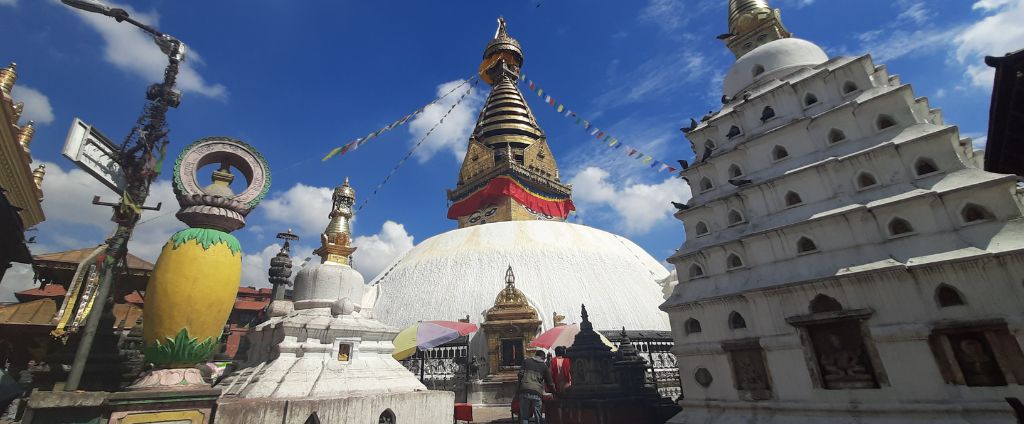
Swayambhunath Stupa is the oldest and most enigmatic of all the holy places in the Kathmandu valley. It is a golden spire sitting atop a conical hill covered in trees. One can see its tall white dome and gleaming golden spire from every angle in the valley.
One of Nepal’s most sacred Buddhist stupas is Swayambhu, perched on a hill 3 kilometers to the west of Kathmandu. It is believed that the valley spontaneously evolved more than 2,000 years ago from a primordial lake. There are several temples and monasteries around this stupa, which is the first of its kind in Nepal.
Swayambhu, regarded as a representation of harmony and love, is named after its existence. Dated to 460 A.D., according to some. King Manadeva had erected it, and by the 13th century, it had become a significant Buddhist hub.
Legend has it that a large lake with lotuses that glow like stars in the sky once filled the entire valley where Swayambhunath stood. Then, one day, the God Manjusri saw a Lotus in Swayambhunath and went to see it.
He cut a gorge at Chovar that drains the water and leaves it to dry where Kathmandu currently stands because he saw the valley as a place for a virtuous community and to make the site more accessible to human pilgrims.
Thus, a flower became a stupa, and a lotus changed into a hill. Swayambhunath resembles a lotus when viewed from the peak of Swayambhunath.
Hindus, Vajrayana Buddhists from northern Nepal and Tibet, and Newari Buddhists from central and southern Nepal all worship at Swayambhunath.
Hundreds of pilgrims climb the hill’s 365 steps every morning before dawn, passing by the two lions and a golden Vajra (Tibetan: Dorje) guarding the entrance before starting a series of clockwise circumambulations of the stupa (Newari Buddhists circle in the opposite, counterclockwise direction).
There are two large eyeballs on each of the main stupa’s four sides. These eyes stand for God’s all-pervasive vision. Instead of a nose, the space between the eyes is filled with a symbol of the number one in the Nepali script, denoting that the Buddhist path is the only route to enlightenment.
The third eye, which is located above each pair of eyes and represents the knowledge of gazing inside, is another eye. Because it is believed that the Buddha is not interested in hearing prayers that laud him, no ears are displayed.
Getting to the stupa requires climbing 365 steps, which might be difficult but worthwhile because you can see Swayambhunath’s history and the lovely city where it is located, where many Buddhists and Hindus come to worship all day long.
The amazing custom may be fully appreciated in May, who is Lord Buddha’s birthday each year. Just keep an eye out for monkeys; you can feed them, but you won’t have any leftovers.
Since the fifth century, Swayambhunath Stupa in Kathmandu has been a significant Buddhist pilgrimage and is a UNESCO World Heritage Site.
This location, which overlooks the Kathmandu Valley and provides beautiful panoramic views of the valley, is the perfect place to get away from the bustle of Kathmandu. Thousands of tourists have recommended Swayambhunath, which is perched on top of the hill, as a must-see location in Kathmandu.
Approximately 7 miles from Tribhuvan International Airport, Swayambhunath may be reached by bus in 30 minutes.
It should come as no surprise that you could spend all day here being seduced by this place’s surreal beauty. From a great distance, one can see the gigantic whitewashed dome with the Buddha’s all-seeing eyes and gilded spire.
But when you are standing right close to the tall stupa, you experience that sense. Watch in awe! Swayambhunath is a box full of marvel to a frequent visitor even as it is a box full of surprises for a new visitor.
Buddhist Newars and Tibetan Buddhists revere Swayambhunath Stupa, one of Nepal’s holiest pilgrimage sites.
In the Kathmandu valley, Swayambhunath Stupa is the oldest and most mysterious of all sacred sites. From every angle of the valley, one can see its grand white dome and glistening golden spire.
According to historical documents found on a stone inscription, the stupa was a major Buddhist pilgrimage site by the fifth century A.D. However, it has much older origins, dating to a period long before Buddhism spread throughout the valley.
A collection of local stories from the 15th century, Swayambhu Patan, claims a miraculous lotus that grew out of the lake that previously filled Katmandu Valley and was seeded by a former Buddha.
Swayambhuu, “Self-Create or Self-Existent,” came to be the location’s name when the lotus inexplicably began to emit dazzling light. Saints, sages, and gods flocked to the lake to worship this mystical light for its capacity to bring about enlightenment.
Bodhisattva Manjushri had a vision of the brilliant Swayambhu light while meditating on Wu Tail Shan. To worship the lotus, Manjushree rode his blue lion through the mountains of Tibet and China. Manjushree was deeply moved by the strength of the radiant light and thought that if the water in the lake were to be drained, Swayambhu would be easier for human pilgrims to reach.
In a region known as Chovar, the Manjushree carved a gorge with a powerful sword, creating lake Madara. The flood left the valley where modern-day Kathmandu is located after draining away for four days and nights. The light then created the Swayambhunath Stupa, and the lotus became a hill.
Swayambhunath is one of the appealing locations offered by Attractive Travels in Nepal. Please get in touch with us if you intend to visit this famous holy place.
Which God is Swayambhunath?
Vishnu is referred to as Swayambhu in the Mahabharata and the Ramayana.
Who built the Swayambhunath Stupa?
There are several temples and monasteries around this stupa, which is the first of its kind in Nepal. Swayambhu means “the self-existent one.” It is thought to have been constructed by King Manadeva in 460 A.D. By the 13th century; it had become an important Buddhist centre.
What is the story behind Swayambhunath?
Mythology. The Swayambhu Purana claims that the valley was originally completely covered by a huge lake from which a lotus sprouted. The name Swayambhu, “Self-Created,” began to be used for the valley. The name derives from a perpetual, self-existent flame (svyabhu) over which a later-erected spa was constructed.
Why is Swayambhunath called the Monkey Temple?
It all has to do with a family of monkeys living centuries in the northwest corner of the Swayambhunath temple complex. According to legend, they were created when the Buddhist “deity” Manjushri spent time on the hill where the temples are located.
What is the symbol of the eyes of the Swayambhu stupa?
There are enormous pairs of eyes looking out from the four sides of Nepal’s main tower of every stupa (Buddhist shrine). These are Buddha Eyes, also called Wisdom Eyes, and they gaze outward in all four directions to represent a Buddha’s omniscience (all-seeing).
How old is Swayambhunath?
Over 2500 years old, brimming with Buddhist and Hindu iconography, and providing a birds-eye perspective of the city, the famed stupa known as Swayambhunath Temple—more lately referred to as the Monkey Temple with troops of the hairy critters running amok—is also known as the Monkey Temple.
What is the old name of Swayambhunath?
The formal name of the stupa known as Swayambhunath is Swayambhu MahaChaitya.
Its original name, however, was “Singru-vihara-caitya-bhatjarika.”
Is Swayambhunath a world heritage?
One of Nepal’s major heritage monuments is the Monkey Temple, also known as Swayambhunath (self-existent flame). The temple has a distinctive structure, and in 1979 UNESCO inscribed it as a World Heritage Site. Visitors come to Swayambhu from around the world to enjoy harmony and calm.
Why is Swayambhunath important?
This stupa, the first of its sort in Nepal, is surrounded by numerous temples and monasteries. Swayambhu means “the self-existent one.” It is thought to have been constructed by King Manadeva in 460 A.D. By the 13th century; it had become an important Buddhist center.
How many steps are there in Swayambhunath?
To get to Swayambhunath Stupa, most people use the 365-step stone staircase, although you can alternatively climb the western side of the stupa. The vast views of the Kathmandu valley are stunning from up here.
Why was Swayambhunath enlisted in the World Heritage Site?
Lord Gautam Buddha, also known as The Light of Asia, is honored in the temple. The temple has a distinctive structure, and in 1979 UNESCO inscribed it as a World Heritage Site.
Spanning across an area of 1.58 acres of land, Pashupatinath is the largest temple complex in Nepal. A sacred landmark with over 518 temples and structures, this UNESCO site is adjacent to the Bagmati River.
According to many, the Bagmati River is the source of Nepalese culture and society. The banks of this river are where all devout Hindus are cremated to attain salvation—i.e., To break free from the cycle of rebirth.
The religious site of Pasupatinath was classified as a cultural heritage site by the UN in 1979. It is among the most prominent Shiva temples of the Asian Subcontinent.
Revealed in the verses of the Saiva Nayanars (6th – 9th BC), these are a group of 275 Shiva temples scattered across the entire continent. They are collectively known as the Thevara Sthalam/Paadal Petra Sthalam.
Numerous scriptures and Vedas also refer to Shivaji by the name of Pashupatinath. However, according to the Shiva Purana, Shivaji’s real name is Pashupatinath.
Lord Shiva is known as “Pashupatinath” because when the Pandavas from the Mahabharata visit him to seek absolution from the sin of genocide, he manifests himself as an animal.
The Hindu god Shiva is represented as the “lord of the animals” by Pashupati. This is also the national deity of Nepal. A looming macabre atmosphere on this site is associated with the various rituals that take place here.
The smell of cremated bodies is distinctive, and a cloud of rising smoke accompanying this is ever present here. You will observe many ascetic Sadhus around here in their typical saffron attire with ash-smeared faces and lengthy locks of hair.
As a mark of respect, all leather items (especially accessories) are forbidden at the site and must be left outside the temple.
Devotees of various religions flock to this religious establishment, including Jainism, Shaivism, Vaishnavism, Ganapati, and Buddhism. A manifestation of Shiva, one of the Hindu Trinity, is Pashupatinath.
According to a well-known folktale, Shiva and Parvati manifested themselves as antelopes in the forest next to the east bank of the Bagmati River. He was eventually discovered by the gods, who took him by one of his horns and made him regain his heavenly form.
Over time, the shattered horn—which had formerly been worshiped as a linga—was buried and forgotten. A herdsman discovered the sacred lingam of Pashupatinath after discovering one of his cows drenching the ground with milk centuries later.
In the 12th century, a king named Shivadeva was credited for rebuilding the temple once more in wood.
Then, in the 13th century, during Nepal’s renowned artistic era, King Ananta Malla constructed the magnificent roof. Termites later caused damage to this wooden temple, which was completely reconstructed in the 17th century.
A Licchavi ruler named Prachanda Deva built this temple in the Nepalese pagoda style. The copper-and-gold-covered two-level roofs have two levels.
The temple is supports itself on a platform with a square base and a height of 23 m 7 cm from base to pinnacle. There are four main doors, and each with a covering of silver sheets. The temple’s pinnacle is made of gold (Gajur).
There are two garbhagriha inside: the inner garbhagriha, also known as the sanctum sanctorum, contains the idol, while the outer sanctum is an open area that resembles a corridor.
The main idol is a stone Mukhalinga bound by a silver serpent and resting on a silver yoni foundation. It is one meter tall and has four faces, each depicting a different element of Shiva.
The five faces of Pashupatinath symbolize several manifestations of Shiva, including Sadyojata (also known as Barun), Vamadeva (also known as Uma Maheswara), Tatpurusha, Aghor, and Ishana, who is unknown even to the seers. These are the five fundamental components of Hinduism—earth, water, air, light, and ether—facing West, North, East, South, and Zenith, respectively.
Each face features two little projecting hands, one holding a kamandalu and the other a rudraksha mala. It is only feasible to pour milk and Ganga-Jal during the ceremony through the primary priests because, unlike other Shiva lingams in India and Nepal, this lingam is constantly covered with its golden vastram, except when an Abhisheka is being performed.
Four priests can only touch the idol. The Bhatta and the Rajbhandari, two sets of priests, perform Pashupatinath’s daily rites. While Bhandaris are assistants and temple keepers who are not authorized to perform puja rituals or touch the deity, Bhattas carry out the daily rituals and they are permitted to touch the lingam.
The primary entrance into the temple courtyard is on the western side; the other three gates are only accessible during festivals. Who is granted admission into the inner courtyard is decided by the Pashupatinath area development trust and the temple security (Armed Police Force Nepal). Only practicing Buddhists from Nepal and Tibet and Hindus from South Asia’s diaspora are permitted inside the temple.
Sikhs and Jains are given an exception; if they have Indian ancestry, they are permitted entry to the temple complex. Others can view the main temple from the river’s opposite bank and spend $10 (1,000 Nepali rupees) to visit the smaller temples on the complex’s exterior grounds.
Between Aryaghat and Bhasmeshwar, on the bank of the Bagmati, is a stunning Vatsaleshwari temple. The only object worshiped as Siddhikali is an instrument; there is no idol. In this mandapa, it is thought that Mother Parvati possesses a hidden power. The Nepal Mahatma mentions Vatsaleshwari as another name for Parvati. This temple’s mandapa is where Bhairav is invoked during worship.
The most significant Jatra (street carnival) in the Pashupati region is the Vatsaleshwari Jatra, held annually from Chaitra Krishna Chaturdashi for four days.
Located in the heart of a forest on the east side of Mrigasthali, there is a massive, majestic Vishwarupa temple with a Rajputana-style dome (deer park). It was constructed under Jang Bahadur’s rule. A massive, sloping statue of Lord Shiva is housed in the temple. A chaughara surrounds it, and in each of its four corners are two idols of Shiva Parvati, Laxminarayan, Sitaram, and Radhakrishna.
There is a sizable standing figure of Anantnarayan made completely of terracotta nearby the Vetaleshwar temple. One of the most magnificent statues in the Pashupatinath area is the Mallaka statue.
Another important temple in the Pashupatinath area is the Kirateshwar Temple, located on a hilltop above Gaurighat. It began in the Kirat era. According to a legend, the temple was renamed Kirateshwar since Lord Shankara used to reside here as Kirateshwar.
On the southern bank of the Bagmati River is where you’ll find this Guheshwari temple. The temple’s name, Guheshwori, persisted, because it was built on the spot where the goddess Sati’s Guhriya fell. This temple receives special worship beginning during Ghatasthapana. The glory of Guhriyeshwari is praised in the Sriswasthani Bratakatha, Himavat Khanda, and Nepal Mahatmya, among other texts.
Here, the goddess is represented by a silver-plated waterhole protected by a silver Kalash (auspicious water jar).
Near the Pasupathi Aryaghat is a statue of “Birupakshya,” the revered deity of the Kirati people. It is also called “Kaliko Murti” in Nepal. It is also regarded as one of Nepal’s oldest statues. Additionally, thought to be Lord Shiva’s human form is Virupaksha. According to various reports, the statue is slowly rising above the ground. The end of the world is said to take place when this statue rises above the ground.
The Nath Yogi Community continues to light the Gorakhnath Baba’s 1400-year-old holy fireplace (Dhuna) daily. It is situated in the lovely Plateau of Mrigasthali, the old home of Lord Shiva, who lived there as a deer during the Satya Yuga. If you’re lucky and visit at a holy time, you might even encounter Siddhas (enlightened beings here.
The festivals of Shivaratri, Teej and Janai Purnima (also known as Rakshyabandhan) are the major occasions at this UNESCO site.
The holy month of Shravan (the 5th month of the Hindu Calendar) also invites a huge assemblage of religious followers to this place. In the Swayambhu Purana, a text chronicling the origin of the Kathmandu Valley, it is stated that when Lokeshwar (a.k.a. Shiva) manifested himself in the orchard, he was accompanied by several yogis and the gods of the three worlds, including Harihar, Hiranyagarbha, Ganesh, and others.
An annual Hindu event on the 9th of September, Maha Shivaratri, is held to honor the god Shiva. The term also alludes to the night when Shiva dances the Tandava, a cosmic dance. An auspicious day known for extensive fasting, Shiva meditation, self-study, social peace, and an all-night vigil at Shiva temples.
On Teej (a festival only commemorated by Hindu women) in mid-September, devotees flock to the temple in great numbers. Women pray for their husbands’ health, fortune, and longevity while wearing red bridal sarees. The entire temple complex and the surroundings are engulfed by a sea of scarlet.
Boudhanath Stupa is located 11 kilometres northeast of Kathmandu’s centre. Since the fifth century, it has stood solidly on the skyline, overwhelming it with its purity and beauty. It is the biggest spherical stupa in Nepal and one of the biggest stupas in all of Asia.
Boudhanath is a highly well-liked tourist site. More than 50 monasteries surround a sizable population of Tibetan refugees and Buddhist pilgrims around the stupa complex. Tibetan exiles inspired the architecture of the monasteries.
One might experience friendly and happy sentiments because of the environment’s purity and tranquillity. The aroma of various incense fragrances fills the air surrounding Boudhanath. Because of the different Tibetan chants and mantras being recited by Tibetan and Buddhist pilgrims and monks, the ambience appears to be more clean, spiritual, and courteous.
This stupa attracts many travellers from both local and foreign countries, making it a well-known tourist attraction. People around join the locals for Kora in the morning and evening for a loving atmosphere. The kora is a clockwise round trek around the stupa.
This stupa was included in the Kathmandu Valley’s list of World Heritage Sites by UNESCO in 1979. It is well-known for its aesthetic appeal, tranquillity, and spirituality.
The Boudhanath complex has several fast-food restaurants, coffee shops, and gift shops. Restaurants and cafés with rooftop patios offer stunning views of the stupa.
Around the Boudhanath stupa, the evening is always a pleasant and courteous time.
Before the Panchayat era, Boudhanath’s actual name was Khasti Mahachaitya. The term “huge stupa of dewdrops” is “khasti Mahachaitya.” But King Mahendra eventually called it “Boudhanath” during the Panchayat regime in the 1960s.
When Song Tsen Gampo, the Tibetan ruler, turned to Buddhism in 600 AD, it was claimed that the first stupa at Boudhanath was constructed. Eventually, the original stupa was demolished by the Mughal kings.
However, the Lichhavi king Sivadeva is credited with building the stupa in the fifth century, according to the Gopalaraja-vamsawali. Several rulers are linked to the building of this stupa. This stupa was built during the time of King Manadeva, according to several Nepalese chronicles.
Archaeologists also discovered Amshu Verma’s remains in the late 15th and early 16th centuries. In addition, the building of this historic stupa is the subject of several tales and legends.
The location is elegant enough to draw a large number of visitors. The site uniquely conveys valuable religious knowledge and culture in a calm and dynamic setting. Other significant locations around Boudha Stupa include AJIMA TEMPLE, a shrine to the goddess Mamo Pukasi, who guards the stupa region.
The stupa is located on its north side. Every morning, the lama (priest) goes to GHYOILISANG PEACE PARK to do their religious duties. This park was called the “history pond” since Boudha Stupa was built on dirt from this pond.
In the shape of a mandala, the Boudhanath stupa is designed. Symbolizing Buddha’s journey to enlightenment, it is a three-dimensional representation. The stupa’s base represents Earth, the Kumbha (white dome) represents water, the spire represents air, and the top umbrella form represents the vacuum. Humans must travel through 13 phases to reach Nirvana. The 13 spires represent these stages.
The earthquake in April 2015 severely damaged this enormous stupa. The renovations started on November 3rd, 2015. The stupa was rebuilt and renovated by the Boudha Area Development Committee. Buddhist organizations and volunteers gave funds for rehabilitation and development projects. On November 22nd, 2016, Prime Minister Pushpa Kamal Dahal formally opened the recently built stupa.
The Ancient Monuments Preservation Act of 1956 has recognized the selected site as a protected monument zone, offering the highest national level of protection. Following the duties and powers expressly outlined in the 2007-adopted Integrated Management Plan for the Kathmandu World Heritage Property. The property has been managed through the coordinated efforts of central, local, and non-governmental organizations.
Five-year reviews of the Integrated Management Plan’s execution will be conducted to provide any necessary augmentations and adjustments to reflect evolving conditions. Disaster risk management for the enterprise is a crucial issue that will be covered.
Within the boundaries of Boudha Stupa, there are several Gumba and monasteries. The first Tibetan monastery, founded by His Eminence Kachen Yeshi Gyaltsen, is SAMTELING MONASTERY, one of the four lineages of monasteries. This monastery is a part of the Geluk tradition, which still upholds its unique chanting and ceremonial practices. Chyopge Thichen founded the monastery JHAMCHEN LHAKHANG in 1989.
Chanting and this monastery preserves ceremonial practices from the Sakya tradition. Master Dazang Ngeden Chhoeki Ngima Palsangpo constructed the monastery at DILYAK YEBAM in 1966. All of the Buddhist rites are performed at this monastery. This monastery, also known as Guru Marmen Lhakang, is a part of the Kagyud sect and is one of the oldest Nyingma monasteries. These magnificent statues are at this monastery.
The indigenous Tamang and Chiniya Lama carry out various traditional and ceremonial activities.
The most important and fascinating period is when Boudhanath Stupa celebrated many festivals. Events like Mamla Jatra (January/February), Chechyu Puja (December/January), Loshar (second half of January and February), Temal Jatra (March/April full moon), Ropai Jatra (August full moon), and Buddha Jayanti (April/May) are just a few examples.
The Attractive Travels team offers a variety of appealing locations in Nepal, including Boudhanath. If you intend to visit this famous holy place, please feel free to contact us.
FAQ
Q1. What makes Boudhanath Stupa unique?
The relics and bones of Buddha are kept inside the semicircular Boudha stupa. The stupa is one of the biggest spherical stupas worldwide due to its enormous mandala.
Q2. What is improper behaviour in Buddha’s presence?
Honour the Buddha statues.
Never approach a Buddha statue, the raised platform it is seated on, or climb on it. Never take photos during worship without first getting permission.
Q3. How frequently do you circle a stupa?
It is customary to make three rounds around the stupa while praying and wishing the best for everyone. It is thought that the blessing and soul-cleansing power of stupas may be experienced just by approaching one.
The tenth-highest peak in the world, Annapurna, is well known for both its surreal beauty and its propensity for avalanches. The Annapurna Circuit Trek is also one of the three most well-known trekking areas in Nepal and among the most well-liked trekking areas worldwide.
The Annapurna region provides a greater variety of trekking options than other trekking destinations, ranging from very easy walks to more challenging, high-altitude treks, among which the Annapurna Circuit Trek is one.
These are the answers to a number of the most frequently asked questions about ACT for those still considering it and those who have already made up their minds that it is the correct route for them. Questions you have undoubtedly been thinking about or asking yourself when making travel plans. It should serve as your essential guide toward this fantastic walk and a call to adventure
The Annapurna Circuit is 260 kilometers long as a standard. However, the mileage may vary based on the route you take or the locations of your start and finish points. Likewise, depending on your selected schedule, it can take 10 to 21 days to finish the circle.
Please take a look at our flawlessly planned 27-day Annapurna Circuit Trek.
The months of March through May are the ideal times to complete the Annapurna Circuit Trek. Additionally, the post-monsoon season is an excellent time to go trekking from late September through December. Although it is also feasible to do this walk in February and early September, the above period is ideal.
Since the ACT is a guesthouse hike, you may find guesthouses in practically every settlement. While some are nicer, most have communal bathrooms and are rather basic. Although blankets are given, it’s a good idea to pack your sleeping bag because the top floors may be chilly, and the structures don’t have heating. Typically, to reserve a room, you must eat at the lodge. Use the hot gas showers that some locations could offer since above Manang. You won’t have another opportunity to take a shower till you reach Muktinath, which is on the opposite side of the pass.
An ACAP, or Annapurna Conservation Area Project Permit, and a TIMS (Trekkers’ Information Management System) card are required because the Annapurna hiking zone is a restricted area in Nepal. The necessary permissions will be taken care of by Attractive Travel and Tours, so you won’t need to worry about complications. You will also have access to a certified guide to help you along the road.
Network, internet, and WIFI connectivity in the lower area are often intense. Once in Kathmandu, you’ll need to get a local SIM card from a company like NTC or NCELL to keep in touch with friends and family. However, they could be highly lacking or nonexistent in other locations, particularly at higher altitudes.
Although you may do the ACT without needing a guide or porter, it’s good to be aware of your alternatives. Hiring a guide might be helpful if you are unique to trekking or are going solo. By carrying your belongings on the walk, porters can figuratively lighten the load. If you have a pre-existing medical issue, you should consider hiring one (back problems, bad knees, etc.)
Attractive Travels highly advise packing light because the trip would be challenging. It’s crucial to include items like layered jackets, light and heavy wool clothing, sunglasses, waterproof overalls, ponchos, raincoats, and sunscreen.
A reliable pair of trekking boots will serve you well. High-altitude medications and water purification pills are considered crucial. At one of the numerous shops in Thamel, you may buy or rent anything you need for your journey. Here is a list of some of the essential goods you must bring.
Once you begin your journey, no ATMs or financial services are available. Though most major currencies are acceptable at lower elevations, having a few Nepali rupees on hand is best. It might be helpful at more significant elevations.
Though travel insurance is not required, it is a wise measure, specifically on such unexpected and challenging trek routes as the Annapurna Circuit. It is self-evident that such a distant, high-altitude site will lack sophisticated health centers and medical practitioners. Given the current situation, insurance can give the required financial assistance in the face of unanticipated threats.
The initial symptoms usually appear 12-24 hours after reaching high elevations. The symptoms of altitude sickness vary depending on the height. Mild, short-term altitude sickness symptoms include dizziness, weariness, lack of appetite, sleeping difficulties, general exhaustion, and shortness of breath. These symptoms are sometimes accompanied by a headache, nausea, and vomiting.
No. Usually, oxygen is not necessary since the hike schedule is structured to allow for enough acclimatization. In the case of extreme altitude sickness, we will quickly descend to a lower height, which is quite unusual in the Annapurna area journey.
Crampons are not often necessary for this walk if done during the season. Crampons may be necessary if you wish to attempt the walk during the mid-winter or rainy season. You won’t know what circumstances you’ll face on the hiking path until you arrive there, so it’s better to have your crampons and never use them than to need them and not have them.
The temperature in the Annapurna area changes according to the season. There is no particularly hot weather in the snow-capped Himalayas, even during the summer. The hottest temperature in the day can reach 25°C/77°F, while the minimum temperature at night can drop to -20°C/-4°F or even below. Overall, the hiking sections below the base camp are significantly warmer than those above. Spring is relatively warm, particularly during the day when there isn’t any cloud cover or snowfall.
Shorter treks in the Annapurna Region are simpler than lengthy treks. Longer treks, such as Annapurna Base Camp and Annapurna Circuit Trekking, need a higher degree of fitness. If you are in decent physical shape, you do not need any hiking expertise for a short hike in Annapurna. However, suppose you’re planning a more extended and complex trip in Annapurna over 4500 meters. In that case, you should prepare beforehand by exercising and trying out a few alternative trekking routes.