Who Are the Sherpa People? History, Culture and Life in the Himalayas
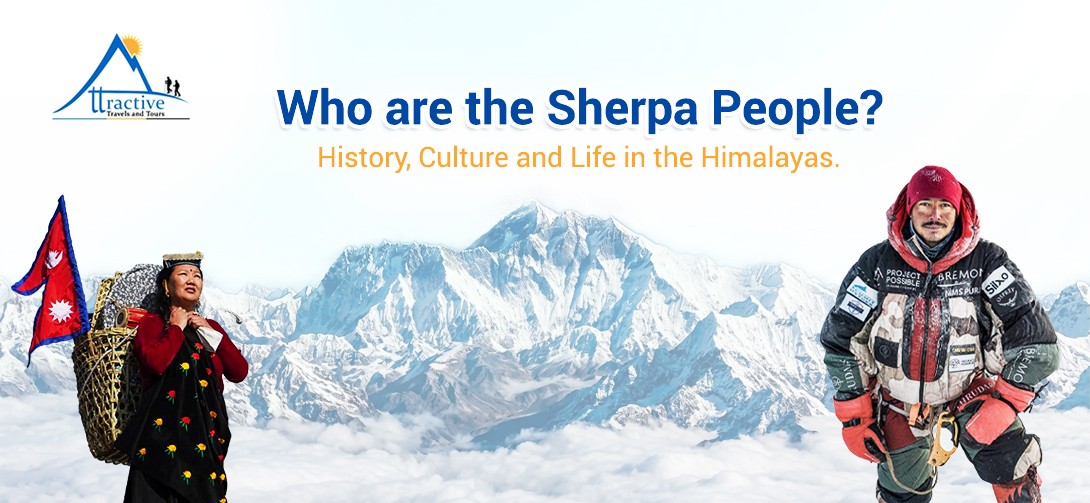
At nearly every Everest Base Camp photo, summit success story, and high-altitude rescue in the Himalayas, there is often a Sherpa presence behind the moment.
Sherpa guides and climbers have supported expeditions, carried supplies, prepared routes, and helped people through difficult mountain conditions. Yet many travelers know the name without knowing much about the people themselves.
The Sherpa People are an ethnic group that speaks a unique language, has traditions and culture, beliefs, history, and a homeland in the Himalayas. Their story has much more to say than just being mountain climbers.
For many centuries, the Sherpas have been living in mountain settlements, farming and raising cattle, trading on Himalayan trails.
This guide explores where the Sherpas came from, how they settled in the Everest region, and how their environment shaped their daily lives.
It also looks at their language, religion, relationship with the mountains, role in mountaineering, and the ways modern tourism has changed their communities while keeping their cultural identity alive.
Explore the Everest region with Attractive Travels and Tours.
Where the Sherpa People Came From
The Sherpas originally migrated from the Kham region of eastern Tibet into northeastern Nepal. Historical accounts generally place this migration around 400 to 600 years ago.
The movement was likely influenced by conflict and the search for new grazing areas and suitable land for settlement. Groups gradually crossed the high Himalayan passes and established communities in the Solukhumbu region.
“Sherpa” is a Tibetan word for “eastern people,” which refers directly to the direction they traveled from. Once they settled in Nepal, a good relationship was established between the Sherpas and the mountains they were surrounded by.
The entire culture of these people, from the way they settled, worshipped, farmed, and traded, developed based on the mountains surrounding them.
Sherpa Identity: More Than an Occupation
Outside Nepal, the term “Sherpa” is commonly understood as being used in a general sense to refer to a mountain guide or porter.
This is a misunderstanding which should be corrected. The term Sherpa refers to an ethnic community with a rich heritage and culture. Some Sherpas have become very accomplished climbers, but the term does not describe a profession.
An Ethnic Group, Not a Job Title
The Sherpa people are an ethnically unique group whose culture has been developed over many years in the Himalayan region. While many Sherpas are engaged in tourism and mountaineering, there are many others who work in sectors such as education, commerce, agriculture, hospitality, public service, among others.
It is due to their experience in this field that the Sherpa have earned themselves a reputation as mountaineers, combining knowledge, experience, physical adaptations, and familiarity with the Himalayas.
The Sherpa Language
Sherpa language is derived from the Tibetan language and is not Nepali. The Sherpa language is still in use among the Sherpas and serves as an important element in culture. Language helps to pass on stories, traditions, native phrases and knowledge from generation to generation.
Some of the Sherpas speak many languages, including Nepali, due to schooling, tourism, businesses and travel. The Sherpa people need to keep their language to keep their past alive as well as move ahead in life.
Religion and Spiritual Life
Tibetan Buddhism is deeply rooted in Sherpa culture. It is practiced on a day-to-day basis, in meetings, festivals, monasteries, prayer flags, mani walls, and so forth. Monasteries are vital institutions that act as centers for praying, performing religious ceremonies, and cultural activities.
Anyone who travels through the Sherpa villages will find Buddhist monuments and prayer flags during the journey. There are also mountains that play an integral role in Sherpa lives. Mountains like Mount Everest do not just present a difficult challenge to climb. Many of them are also considered to be holy sites.
Daily Life in the High Himalayas
Life at altitude has shaped Sherpa communities in practical ways over many generations. Thin air, a cold climate, steep terrain, and limited farmland have all influenced what people grow, how animals are raised, how goods move around, and where settlements get built.
Traditional ways of life grew out of making the best use of whatever resources the mountain environment offered.
Farming and Herding at Altitude
Cultivation of potatoes and rearing of animals have long played a crucial part in the lives of people living in the mountains. Potatoes are ideally adapted to grow in mountainous areas. Similarly, the yaks could easily withstand cold temperatures and walk through rugged terrains.
The yaks produced milk as well as other dairy products. Besides, they could easily carry cargo through rough terrain. Trade was another key source of livelihood based on ancient trade routes linking Nepal and Tibet.
Villages Built Around the Trail
Sherpa settlements developed through the old trade routes and ended up becoming important places where trekkers could have some time to rest. Namche Bazaar, for instance, grew into an important business hub on the route that leads to Mount Everest.
Another example of Sherpa settlements is Khumjung, which is surrounded by agricultural land, Sherpa homes, monasteries, and mountains. Even with all the tourists, there are still some true Sherpa villages in these settlements.
The Sherpa Connection to Mountaineering
The relevance of Sherpa people to mountaineering in the Himalayas should not be ignored. The knowledge and experience that the Sherpas have about the mountain regions have played an important role in the success of different expeditions for many years.
It should be noted that the involvement of the Sherpas does not only include carrying gear. There have been many Sherpa climbers who have contributed to route preparation and other activities.
A History Written Into Everest’s Story
The successful climb of Mount Everest with Edmund Hillary by Tenzing Norgay in 1953 was undoubtedly the most popular event where the contribution of the Sherpas was seen in the history of Everest.
The accomplishment of these two climbers was an important event in the field of mountaineering. It made Tenzing Norgay one of the most famous mountaineers of that age. However, this accomplishment was just one episode of a long story of Sherpas’ skills on Mount Everest.
The Physical Advantage of High-Altitude Adaptation
The skills of the Sherpa climbers cannot be attributed solely to their experience. Scientific studies of the effects of altitude on populations have revealed that living at elevation for generations may result in physiologic adaptations that will assist the body in working in hypoxic environments.
The Sherpas are known for their efficient use of oxygen and many other adaptations that allow their bodies to work effectively under high altitude conditions. While these adaptations can give some advantage, they do not make mountaineering a safe activity for the Sherpa climbers.
Sherpa Culture Today
The Sherpa people have undergone great transformation due to the growth of tourism and mountaineering in the Everest region. The expansion of tourism has created job openings in various areas such as guiding, treks, lodging and even transportation.
Education, improved communications and exposure to urban centers have transformed the way of life of the new generations who are spending some time away from their traditional settlements.
At the same time, the Sherpa culture did not disappear. The practice of Buddhism, the celebrations and festivals, traditions of the family, language, cuisine, and community gathering continue to play an important role in Sherpa culture.
Traditional aspects and modern lifestyle exist simultaneously, thus allowing for the development of the culture rather than keeping it at a fixed point. Such awareness allows for the prevention of viewing Sherpa communities as relics of the past.
Meeting the Sherpa People on an Everest Region Trek
A trip to the Everest region allows tourists to encounter Sherpa communities as an integral part of everyday life and not only as a part of the picturesque environment.
In this trekking tour, travelers have a chance to witness villages, monasteries, farms, bazaars, and even houses where people live and work. Staying in local guest houses and trekking in the vicinity of Namche Bazaar and Khumjung will offer more insights into the region.
Interaction with the locals can also make the trip more enriching. It is important for travelers to remember that such communities are not places that were built specifically for tourism purposes. These are homes and workplaces for the locals.
Respecting their religion, following local traditions, asking permission before photographing them and showing an interest in their history can all contribute towards making the trip more respectful. The Sherpas continue to mold the trails and communities experienced by the travelers.
Why Choose Attractive Travels and Tours for Your Everest Region Journey
Attractive Travels and Tours is a licensed tour and trekking operator based in Kathmandu. We provide tourists with opportunities to tour and trek through Nepal, Tibet, and Bhutan.
With diverse trekking and touring packages, the company assists tourists in touring the Himalayas using its well-coordinated schedules and local knowledge. Attractive Travels and Tours is associated with the Nepal Government, Nepal Tourism Board, NATA, KEEP, and PATA.
Attractive Travels and Tours offers certified government guides to aid visitors in discovering the region of Everest safely and in a manner befitting the environment. It is important to note that the trip is not necessarily focused on getting to the base camp, but also the discovery of the villages, monasteries, culture and people along the route. Travelers will get to know the Sherpa People better and see the area in person.
Contact Us to plan your Everest adventure.
Conclusion
The Sherpa People are not just a label that comes along with mountaineering news stories. They are a unique ethnicity with their own long-standing history, their own language based on Tibetan, their own religion and culture, and a connection to the Himalayas.
Migration of Sherpas from eastern Tibet, their inhabiting of Solukhumbu, occupations, and help in climbing Mount Everest are some of their characteristics.
The impact of tourism and development continues to alter life in the Everest region. However, the Sherpa culture is as vibrant today as ever in the villages, monasteries, festivals, and family life. A trek in the Himalayas will reveal a lot more than just views of snow-capped mountains for that reason.
Tourists who make efforts to know about the local culture usually return from their trip with a richer experience of it.
FAQs
What does the word “Sherpa” actually mean?
The word “Sherpa” comes from Tibetan words meaning “eastern people,” pointing to the historical movement of the community from eastern Tibet into the Himalayan regions of Nepal.
Are all mountain guides in Nepal known as Sherpa?
Not really, because being a Sherpa is an ethnic identity and not a designation for a profession. There are a lot of mountain guides in Nepal who have a diverse background. However, many Sherpas have managed to establish themselves as excellent guides and mountaineers because of their extensive experience and knowledge of the mountains.
What is the religion of Sherpa people?
The majority of Sherpa villages practice the teachings of Tibetan Buddhism. Monasteries, prayer flags, mani walls, rituals and other religious symbols and practices are widely seen and celebrated in the villages around the area.
Why are Sherpas so good at high-altitude climbing?
Their ability to climb comes from years of adaptation to living at high altitude, acclimatization, experience, and profound knowledge of the surroundings. Still, proper acclimatization and preparations are a must, despite all the factors listed above.
Is it possible to visit Sherpa villages during the trekking to Everest Base Camp?
Yes, it is because the treks to the camp usually go right through Sherpa villages like Namche Bazaar and Khumjung.
Download PDF