Nepal vs Bhutan Travelling Guide 2026/2027:Travel & Adventure Compared
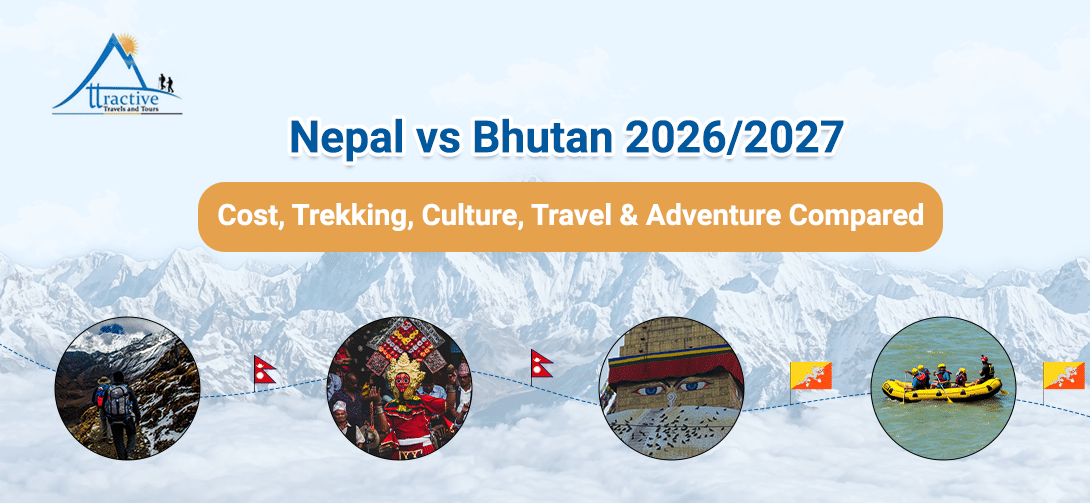
Nepal and Bhutan are two Himalayan neighbours, but traveling through them provides very distinct experiences. This Nepal vs Bhutan Travel Guide highlights the distinctions between the two countries in terms of expenses involved in travelling, visa requirements, trekking, cultural practices, wildlife, and the ideal time for visiting.
Nepal is renowned for its high mountains, trekking routes, adventure sports, and rich culture. Bhutan draws tourists because of its valleys, Buddhist monasteries, traditional buildings, and well-managed tourism industry. The comparison will assist you in determining the better location to go, whether you plan to go on a trekking or cultural vacation.
You may also visit Bhutan and Nepal on one holiday. You get the opportunity to experience the diverse landscape of Nepal and the traditional mountain culture of Bhutan.
Nepal vs Bhutan at a Glance
Both Nepal and Bhutan have Himalayan terrain along with Buddhist culture. Nevertheless, their travel experience is not the same. While Nepal is more flexible and diverse, Bhutan’s tourism is more planned and organized.
| Travel Factor | Nepal | Bhutan |
| Landscape | Mountains, hills, forests, rivers and plains | Mountain valleys, forests and high passes |
| Culture | Hindu and Buddhist traditions with diverse communities | Strong Buddhist traditions and preserved customs |
| Entry rules | Visa on arrival for eligible nationalities | Visa or permit requirements depend on nationality |
| Trip style | Independent travel and guided tours | More structured and guided experiences |
| Best for | Trekking, adventure, wildlife and culture | Monasteries, dzongs, nature and heritage |
Mount Everest is located in Nepal, which is known as the Roof of the World. In Nepal, one gets to enjoy anything ranging from urban sightseeing to treks at high altitudes. The tourists visiting Nepal can opt for various Nepal tours according to their liking and budget.
Bhutan is smaller and known for its monasteries, dzongs, traditional villages and scenic valleys. Its tourism approach focuses on protecting local culture and the natural environment. Visitors can explore historic landmarks while enjoying a slower pace of travel.
This Nepal Vs Bhutan Travel Guide proves that there is something unique about both countries. It all depends on your taste – if you are looking for diversity and adventure or culture and peace.
Cost: How Travel Spending Differs
Travel costs are one of the main differences between Nepal and Bhutan. Nepal offers accommodation, transport and activities across a wide range of budgets. Bhutan has a daily Sustainable Development Fee (SDF) for most international visitors.
The current SDF is USD 100 per adult per night. Children aged 6 to under 12 pay USD 50 per night, while children under six are exempt. Most international visitors also pay a one-time visa application fee of USD 40. These charges are separate from flights, accommodation, meals, transport and personal expenses.
The SDF supports Bhutan’s public services, environmental protection and cultural preservation. It is not an all-inclusive tour payment. Visitors must also budget for accommodation, guides, transport, meals and activities.
Nepal does not have a similar daily tourism fee for most international visitors. Travellers can choose budget guesthouses, mid-range hotels or luxury accommodation. Local transport and restaurants are also available at different price levels.
A short tour in Nepal may include sightseeing in Kathmandu. At the same time, a longer holiday can cover Pokhara, Chitwan or a trekking region. The total cost depends on the route, accommodation, transport, group size and activities. A reliable travel agency can help organise these arrangements according to your budget.
The most important thing about this Nepal vs Bhutan Travel Guide is that Nepal gives more options to people with varied budgets. The cost system in Bhutan is more systematic; thus, people need to calculate the SDF and other costs before finalizing their travel plans.
Visas and Entry Rules
Visa requirements are another important part of planning a trip to Nepal and Bhutan. Both countries have different entry systems, so travellers should check the latest rules based on their nationality.
Nepal provides visa on arrival at Tribhuvan International Airport for eligible nationalities. Visitors can also complete the online application process before travelling or apply through a Nepali diplomatic mission.
Current tourist visa fees are USD 30 for 15 days, USD 50 for 30 days and USD 125 for 90 days. Some nationalities must apply in advance. Indian citizens do not need a visa to enter Nepal.
Most international visitors need an approved visa to enter Bhutan. Applications can be completed online or submitted through a tour operator or hotel. The visa fee is USD 40, in addition to the applicable SDF. Indian visitors follow a separate permit process.
Travelling independently in Bhutan is possible. Visitors do not have to book every part of their trip through a tour operator. However, they must be accompanied by a certified guide while travelling around the country. Treks must also be arranged with an accredited tour operator or guide.
This Nepal vs Bhutan Travel Guide recommends checking entry requirements early. Nepal’s visa process is generally straightforward for eligible visitors. At the same time, Bhutan requires additional planning for its visa, SDF, and guide arrangements. Our travel agency can help you understand these requirements before you visit Bhutan.
Trekking Compared
Nepal is one of the world’s leading trekking destinations. Its trails cross through mountain villages, forests, valleys, and high-altitude regions. Depending on the physical ability and experience of the trekkers, they can opt for shorter or longer treks.
The Everest Base Camp Trek is one of Nepal’s most famous treks. This will take you through the Khumbu region, Sherpa villages, and the Himalayan mountains. Other trekking paths include the Annapurna Circuit, Annapurna Base Camp, Langtang Valley, and the Manaslu Circuit.
Everest Base Camp trek is one of the most preferred treks for tourists who wish to explore the Himalayas. There are also shorter treks available in Kathmandu and Pokhara, Nepal. A base camp trek, circuit trek or multi-day mountain trek requires adequate preparation, appropriate clothing and altitude acclimatization.
For experienced climbers, Nepal also offers peak climbing opportunities. These trips require additional preparation, technical skills and suitable equipment. Travellers should select a route according to their fitness and experience.
However, trekking is possible in Bhutan too. However, the trails here are fewer in number and also more controlled. Treks can take one through valleys, forests, passes, and settlements. Some routes are demanding and require several days of walking.
Altitude is important in both countries. The highest treks in Nepal are at great heights above sea level. Hence, visitors need to take the necessary time to acclimatize. The Bhutanese high-altitude treks also require proper preparation.
The Nepal vs Bhutan Travel Guide comparison is clear for trekking enthusiasts. Nepal has a greater variety of well-established trails, such as the Everest Base Camp trek. On the other hand, Bhutan is a place for those who want a regulated mountain adventure.
Culture and Heritage
Nepal and Bhutan have unique cultures influenced by religion, history, and tradition. Nevertheless, their sites and customs provide contrasting experiences.
Nepal has a diverse mix of Hindu and Buddhist communities, historic cities and traditional festivals. The Kathmandu Valley is one of the country’s main cultural centres, with temples, courtyards, palaces and traditional settlements.
Tourists visiting Kathmandu, Nepal will be able to see Kathmandu Durbar Square, Patan Durbar Square, and Bhaktapur Durbar Square. Such places consist of traditional palaces, temples, sculptures, and courtyards. The Durbar Square structures represent the architectural and artistic tradition of Nepal.
Other major religious sites include Pashupatinath Temple, one of the most important Hindu temples in Nepal, and Swayambhunath, commonly known as the monkey temple.
Nepal is home to several UNESCO World Heritage properties. The historic monuments of Kathmandu Valley form part of a recognised world heritage site listing. Other important properties include Lumbini, Chitwan National Park and Sagarmatha National Park. Each heritage site reflects a different part of Nepal’s cultural or natural history.
Bhutan’s cultural identity is strongly connected to Buddhism. Visitors can explore Paro, Bhutan, a scenic valley known for traditional houses and religious landmarks.
A notable site in the country is the Taktsang Monastery, which is popularly referred to as the Tiger’s Nest. This site is found at the edge of the Paro Valley and is accessible through a well-known hiking trail. The monastery holds great significance for the people of Bhutan.
Some other tourist spots include the Punakha Dzong, which is a fort located at the confluence of two rivers, and the Chimi Lhakhang, which is a temple known for the famous Buddhist saint Drukpa Kunley. One can visit Thimphu, Bhutan’s capital, for a tourism trip.
Festivals are important in both countries. Nepal celebrates Dashain, Tihar, Buddha Jayanti and various local jatras. Bhutan is known for its colourful Tshechu festivals, which feature traditional masked dances, music and religious ceremonies.
Travelers looking for classic Tibet might also consider visiting the greater Himalayan area because of similar Buddhist influence. Still, Tibet is an independent country with specific travel arrangements that should not be mixed with Nepal or Bhutan.
For those who wish to explore places rich in history and spirituality, the Nepal vs Bhutan Travel Guide points out some good locations. Nepal has more options regarding culture, whereas Bhutan offers an interesting Buddhist heritage.
Wildlife and Adventure
Apart from trekking, Nepal also provides various other outdoor activities. These include white water rafting, paragliding, mountain flight, cycling, hiking, and jungle safaris.
Chitwan National Park is one of Nepal’s best-known wildlife destinations. Visitors can take guided safaris and look for one-horned rhinoceroses, deer, crocodiles and different bird species. Bengal tigers also live in the park, although sightings are never guaranteed.
Other activities include rafting on rivers such as the Trishuli and Seti, scenic flights around the Himalayas and adventure activities in Pokhara. Visitors can also combine the Everest Base Camp trek with other experiences in Nepal when they have enough time.
Bhutan takes a quieter approach to adventure tourism. Its forests, mountain valleys and protected landscapes are suitable for nature walks, birdwatching, scenic drives and cultural exploration.
The distinction can be found in the Nepal vs Bhutan Travel Guide. Nepal suits adventurers because of its diversity, but Bhutan is the perfect destination for tourists who want to slow down.
Best Time to Visit Each Country
The best time to visit Nepal depends on your planned activities. Spring, from March to May, and autumn, from September to November, are generally preferred for trekking. These seasons often bring clearer mountain views and favourable trail conditions.
Winter is ideal for trekking at low altitudes as well as visiting places like Kathmandu and Pokhara. Winter is also a good time to go to Chitwan. The period from June to August is the monsoon season in Nepal, which brings lots of rain.
Bhutan is also attractive during spring and autumn. Spring brings blooming flowers and pleasant sightseeing conditions. In autumn, there is usually clear visibility of the mountains, along with traditional festivals. Winter can be quite chilly, especially at higher altitudes.
When planning for a joint holiday, spring and fall are often wise selections. Both have favorable climates for sightseeing in Nepal and traveling in Bhutan’s valleys. Nevertheless, there are certain fluctuations depending on elevation and specific region.
This Nepal vs Bhutan Travel Guide recommends choosing travel dates based on your main interests. Trekkers planning the Everest Base Camp trek should consider trail conditions. At the same time, cultural travellers may prefer dates that match major festivals.
Combining Nepal and Bhutan in One Trip
Going to both Nepal and Bhutan on one trip provides the opportunity to visit two different Himalayan countries. It enables one to visit the cities of Nepal first and later move to Bhutan, where there are temples, dzongs and other cultural settlements.
Kathmandu is a useful starting point for this combination. Direct flights connect Tribhuvan International Airport with Paro International Airport. Drukair and Bhutan Airlines operate flights on this route, with flight times generally around one hour. Schedules can change, so confirm the details for your travel dates.
Attractive Travels offers a published Nepal and Bhutan Tour with a duration of 10 days. The itinerary includes sightseeing in Kathmandu, Patan and Bhaktapur, followed by travel to Bhutan. It also features destinations such as Thimphu and Paro, along with a hike to Taktsang Monastery, also known as Tiger’s Nest.
The itinerary may serve as the beginning of a journey for people intending to visit Bhutan after seeing Nepal. Based on your preferences, we can also discuss changes to sightseeing, accommodation, and travel plans. Attractive Travels is also involved in Bhutan tours, along with customized tour packages.
You can also talk about a vacation that involves trekking or adventure in Nepal prior to going to Bhutan. The right travel agency can help arrange flights, guides, and other things required for Bhutan and Nepal.
The Nepal vs Bhutan Travel Guide method is helpful while planning a joint vacation since it will enable you to know about travel time, visa, and costs prior to embarking on the journey. Don’t forget to factor in airfares, visa costs, SDF for Bhutan, and miscellaneous costs in your budget.
Which Should You Choose?
Nepal and Bhutan are great destinations to choose depending on what you are looking for from your vacation. They both provide beautiful scenery and cultural experiences, but are suited for different kinds of vacations.
Choose Nepal if you want:
- A wider range of trekking routes and mountain adventures.
- Flexible travel plans for different budgets.
- Wildlife experiences, rafting and outdoor activities.
- Historic cities, temples and diverse cultural traditions.
- A mix of short trips and longer holidays.
Choose Bhutan if you prefer:
- Buddhist monasteries, dzongs and traditional villages.
- A quieter and more structured travel experience.
- Scenic mountain drives and nature walks.
- Cultural festivals and preserved local traditions.
- Guided exploration of historic and religious sites.
Select both options if you have 10 days or more. A joint trip will enable you to experience the diverse landscapes of Nepal before uncovering the traditional towns and mountain valleys of Bhutan.
As this Nepal vs Bhutan Travel Guide explains, Nepal is a strong choice for variety and adventure. At the same time, Bhutan is ideal for a slower cultural journey. You can also request customised tour packages if you want to experience both countries in one holiday.
Why Choose Attractive Travels for Your Nepal vs Bhutan Travel Guide Trip
Planning a holiday across two countries involves more than choosing destinations. You also need to consider flights, accommodation, transport, guides, entry requirements, and travel time.
Attractive Travels is based in Thamel, Kathmandu, Nepal, and was founded by Ms. Ranjita Silwal in 2014. The company offers travel services across Nepal and Bhutan, including Nepal tours, trekking trips, Chitwan experiences, Bhutan Cultural Tours and a combined Nepal and Bhutan itinerary.
Depending on your itinerary, arrangements may include accommodation, local transport, guides, porters, flight ticketing and customised sightseeing plans. The team can also help explain the main cost components before you confirm your trip.
This is particularly useful for a combined holiday, where Nepal’s flexible travel options and Bhutan’s daily SDF need to be considered separately. Whether you are planning a cultural holiday, trekking experience or longer journey, Attractive Travels can help prepare an itinerary around your travel dates and interests.
If you are planning the Everest Base Camp trek, a cultural tour in Nepal, or a journey to visit Bhutan, you can discuss your requirements with the team. Contact Attractive Travels through WhatsApp or email to request customised tour packages for your Nepal vs Bhutan Travel Guide trip.
Conclusion
Nepal and Bhutan offer two different ways to experience the Himalayas. Nepal is unique in its diversity, its flexible means of traveling, trekking paths, fauna, and rich culture. Bhutan is well known for its valleys of peace, Buddhism, monasteries, and well-managed tourism industry.
The best choice depends on your interests, budget and available time. Choose Nepal for adventure and variety, Bhutan for cultural exploration and a quieter pace, or combine both if you have enough time.
Use this Nepal vs Bhutan Travel Guide to plan your journey and choose the experiences that matter most to you. Attractive Travels can help organise a trip that brings both destinations together.
FAQs
1. Is Nepal cheaper than Bhutan?
In summary, there are more economical places to visit in Nepal since most tourists do not pay a tourism fee each day. Accommodation, food, transportation, and leisure facilities can be found at various prices. In Bhutan, all tourists have to pay a Sustainable Development Fee that costs 100 USD per day per person (excluding kids under five). You will have a one-time visa fee of 40 USD when visiting.
2. Do I need a visa for each country, and can I travel to Bhutan independently?
Most international visitors need a tourist visa to enter Nepal, although eligible nationalities can obtain one on arrival. Most international visitors also need a visa for Bhutan. Independent bookings are allowed, but visitors must be accompanied by a certified guide while travelling around the country.
3. Which is better for trekking, Nepal or Bhutan?
Nepal is usually more favorable to travelers looking for many treks. There are famous treks including Everest Base Camp, Annapurna and Langtang, as well as treks for those wishing to hike short-distance routes. There are also some amazing trekking trails in Bhutan, though arrangements need to be made through a licensed tour operator.
4. How many days do I need for Nepal and Bhutan together?
A period of about 10 days would be an ideal beginning to such a joint tour. Some days can be spent exploring the Kathmandu Valley, and then one can fly down to Paro and explore Bhutan. A longer stay allows for more time for trekking, wildlife, and other places as well.
5. When is the best time to visit Nepal and Bhutan?
Spring and autumn are generally suitable for visiting both countries. These seasons offer favourable conditions for sightseeing, trekking in many regions and enjoying cultural festivals. The best dates still depend on your destinations and planned activities.
Download PDF