Kathmandu Durbar Square: UNESCO World Heritage Site

Kathmandu Durbar Square: Royal Heritage and Layout
Historically, Kathmandu Durbar Square served as the seat of power where successive kings governed Nepal and new monarchs received their crowns amid the thunderous pounding of drums and trumpets. Today, this majestic site remains just one of the country’s three historic durbar squares and stands as Kathmandu’s most impressive showcase of traditional architecture. Although the devastating 2015 earthquake left its mark and caused a dozen sections to collapse, the complex has successfully preserved much of its timeless beauty.
The Three Layout Zones
The Durbar Square area comprises three loosely connected open spaces:
-
Main Durbar Square (West): Positioned on the western side, this primary zone forms the political and historical heart of the complex.
-
Basantapur Square (South): Located in the southern half, this open area formerly served as a royal elephant stable. Today, vibrant gift shops fill the historic space.
-
Hanuman Dhoka Entrance Area (Northeast): Situated in the northeastern corner, this zone houses the grand entrance to the Hanuman Dhoka complex, with a stunning collection of hidden temples nestled behind it.
Cultural Life and World Heritage Status
Beyond its royal history, the square functions as a bustling public walkway linking numerous city streets. During major cultural celebrations like Dashain, Indra Jatra, Machhindranath Jatra, and Gaijatra, the plaza fills to capacity with festive crowds, echoing its vibrant heritage even though formal coronations no longer take place here. In recognition of its unmatched cultural value, UNESCO designated the entire Kathmandu Durbar Square complex as a World Heritage Site in 1979.
Past Glory of Kathmandu Durbar Square

Historically, the Malla kings—the first rulers to govern independent Kathmandu—used Kathmandu Durbar Square as their capital. Later, Prithvi Narayan Shah conquered the Kathmandu Valley in 1769 and selected the compound as his royal residence. Following his reign, successive Shah monarchs continued to rule the nation from this historic site until 1896.
Although formal archival records are scarce, historians frequently credit the renowned King Sankharadev with establishing this affluent area. Furthermore, experts believe that Ratna Malla, the first monarch of the autonomous city, commissioned the striking three-roofed Taleju Temple located in the northern sector of the compound.
Architectural Legacy and Splendor
In addition to the Taleju shrine, King Ratna Malla is credited with constructing several other prominent temples on the property dedicated to Kotilingeshwara, Jagannath, Mahendreswara, and Mahadev. Spanning a flat five-acre expanse, Kathmandu Durbar Square preserves an intensely ancient and atmospheric feel. Ultimately, with its royal ponds, quadrangle courtyards, and palace-enclosed architecture adorned with historic paintings, the complex remains the undisputed jewel in Nepal’s cultural crown.
Kathmandu Durbar Square’s Top Attractions

Due to several factors, Kathmandu Durbar square is a popular tourist destination. The stunning buildings of worship and expansive courtyards add to the area’s already stunning aesthetics. The area has great historical significance and has been the site of numerous coronation rituals. The following list includes a handful of the many attractions within the square complex.
1. Taleju Temple
At a great height of 36.6 meters, the sacred sanctuary constructed by King Ratna Malla is a temple dedicated to the Goddess Taleju Bhawani. The center of the temple is adorned with a magnificent deity statue with four heads and 10 arms, and the area is charming due to the elaborate metalwork. A sanctum for the Kumari, known as the Living Goddess in Nepal, can be found inside the temple.
2. Jagannath Temple
The octagonal Krishna Temple was built during Pratap Malla’s reign and is completely dedicated to Lord Krishna. According to legend, this worship site was constructed as a memorial to two of his former kings. The walls of this temple are decorated with lovely images of Lord Krishna and two goddesses who are thought to be his wives.
3. Trailokya Mohan Narayan Temple
Lord Vishnu is honored in the complex’s five-roofed temple. The holy sanctum of the temple, which is decorated with antique paintings and portraits of the deity, exudes a magical aura that draws in many worshippers.
4. Kalbhairav Temple
Ancient legend describes Kalbhairav as a terrifying manifestation of Lord Shiva. The god, present in the Durbar Square complex in a great and majestic shape, welcomes several people each year.
5. Hanuman Dhoka
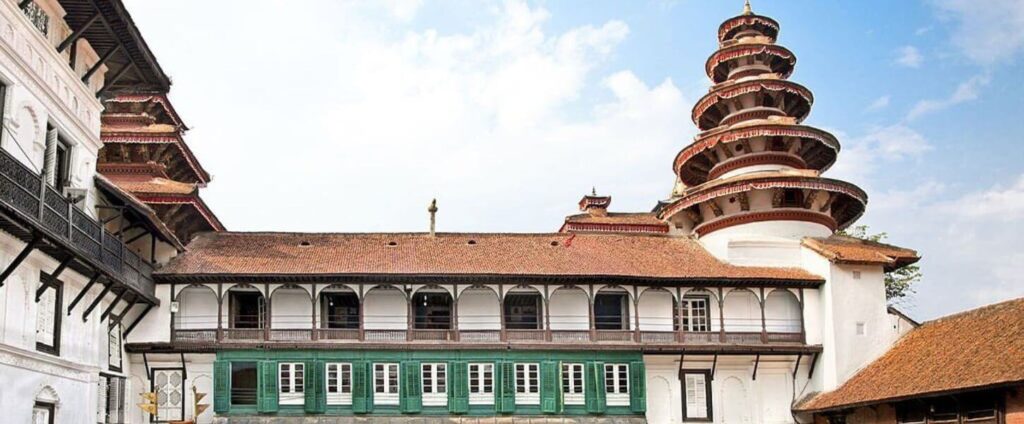
Undoubtedly, the Hanuman Dhoka Palace Complex—which houses a fascinating museum—serves as the primary draw of Kathmandu Durbar Square. Serving as a royal residence until 1886, the structure now welcomes countless residents and visitors daily. Furthermore, this historic destination provides deep insight into the culture and architecture that predominated in ancient Nepal. Inside, the museum offers an exceptional collection of artifacts from the Malla dynasty, while the grounds themselves set the stage for the historic tale of Prithvi Narayan Shah’s rule and Nepal’s unification.
Historic Shrines and Temples of Durbar Square
6. Kumari Bahal
As a stunning traditional palace, the Kumari Bahal houses the living goddess while she serves as the chosen Devi. Builders constructed the three-story structure using red bricks and wood, featuring ornately decorated balconies, windows, and doors that resemble traditional Buddhist Viharas. In the mid-18th century, Jaya Prakash Malla commissioned the building. Additionally, the courtyard holds a stupa decorated with Saraswati symbols alongside a sizable chariot that locals use to transport the Kumari during the annual Indra Jatra celebration. Many believe her presence actively protects the community and the surrounding area. Remarkably, the massive 2015 earthquake barely damaged the Bahal while severely impacting neighboring zones, which villagers attribute to the grace and strength of the Kumari.
7. Sattal Singha
Also known as Silyan Sattal, Sattal Singha operates as a traditional inn. Inside, the structure houses a shrine dedicated to Natyeshwar, the God of Dance. Historians note that builders first established the site during the 12th century.
8. Temple of Kabindrapul
Dedicated to the God of Music, this 17th-century wooden temple—alternatively known as Dhansa Dega—stands as a unique cultural landmark.
9. Ashok Binayak (Maru Ganesh)
Visitors can easily spot the modest, single-story Ganesh shrine of Ashok Binayak in the eastern section of Kathmandu Durbar Square. Protective bars surround the structure, while its interior boasts gleaming gold-plated walls.
10. Gaddi Baithak
Positioned directly across from Kumari Ghar, Gaddi Baithak stands as a striking white neoclassical monument. Following the 2015 earthquake, workers successfully reconstructed the historic building, which Prime Minister Chandra Samsher Rana originally commissioned in 1908 AD.
11. Kotilingeshwara Mahadev Temple
King Pratap Malla created one of his most significant 17th-century structures here: the Kotilingeshwara Mahadev Temple. Architecturally, a round layout topped with three metallic circular roofs characterizes the building.
12. Shiva Parvati Temple
Situated in the heart of Durbar Square’s religious district, the magnificent Shiva Parvati Temple houses Lord Shiva and his consort, Goddess Parvati. Pilgrims and tourists frequently visit the sanctuary, making it just as significant as the Kumari Bahal or Kasthamandap. Bahadur Shah built the temple in the 18th century, covering every square inch of its walls with incredibly detailed carvings.
13. Bhagwati Temple
Originally functioning as a Narayan shrine, the Bhagwati Temple in Durbar Square was constructed by Jagajaya Malla in the 18th century. Historians believe that Prithvi Narayan Shah later removed the original Narayan idol and replaced it with a statue of Bhagwati.
14. Great Bell and Degutaleju Temple
King Rana Bahadur Shah erected the Great Bell in 1797. Today, this magnificent bell stands adjacent to the Degutaleju Temple and rings during daily puja ceremonies. As an integral component of Hanuman Dhoka, the Degutaleju Temple features three tiered roofs and houses a private shrine dedicated to Taleju, the personal goddess of the Malla kings.
15. The Column of King Pratap Malla
Featuring a stone pillar known as Pratap Dhwaj, this landmark originally displayed a statue of King Pratap Malla facing the Degutaleju shrine. Although the 2015 earthquake destroyed the stone statue itself, the majestic pillar still stands.
16. Indrapur Temple and Tana Deval Temple
As its name implies, the Indrapur Temple primarily honors Indra. However, a sacred Lingam inside suggests a dual devotion to Lord Shiva, while a carved Garuda figure on the southern side indicates a connection to Lord Vishnu. Directly in front of the Taleju temple sits the Tana Deval Temple. Featuring three intricately carved doors and painted struts depicting Mother Goddess themes, a protective outer wall encloses the entire shrine.
Getting to Kathmandu Durbar Square
Travelers can easily reach this magnificent heritage site via private or public transportation. Following Amrit Marg, the square sits just three kilometers away from Kathmandu’s city center. Visitors can readily hire local taxis or board public buses, while those preferring a scenic walk can reach the square from central Kathmandu in just over 30 minutes.
Earthquake 2015

After a severe earthquake struck Nepal on April 25, 2015, natural forces destroyed a sizable portion of southern Durbar Square, while physical fractures and crevices damaged the surviving structures. Previously, a devastating earthquake had already struck Kathmandu Durbar Square in 1934. Fortunately, workers immediately renovated the complex back then, restoring it to its magnificent state in no time. However, recovery efforts following the 2015 earthquake have lagged behind expectations.
Kathmandu Durbar Square stands as a historic landmark and a profound source of national pride. Therefore, competent authorities must act swiftly to ensure that the site remains a place of awe for future generations. Historically, the square has anchored Nepal’s cultural heritage, religion, sovereignty, national pride, and economic life. Although natural disasters have altered the complex’s architectural design, its rich atmosphere continues to draw travelers from around the globe.
Essential Tips: What to Know Before You Go
-
Timing Your Visit: To experience Kathmandu Durbar Square more authentically, visitors should arrive early in the morning when crowds are thinnest.
-
The Living Goddess Kumari: The Living Goddess Kumari appears briefly at the Kumari Ghar’s main window between 9:00 and 11:00 a.m., as well as around 4:00 p.m. While local laws strictly prohibit photography during this time, lucky visitors may receive a sacred blessing.
-
Hiring Guides: Furthermore, travelers seeking a deeper appreciation of the site should book a guided tour or hire an expert in advance. Experts strongly recommend securing guides beforehand, as finding authentic local guides on-site can prove difficult amidst unauthorized solicitors.
-
Extending Your Ticket: Although standard tickets cover only one day, visitors can visit the tourist center near Kumari Ghar to exchange their ticket for a free Visitor Pass valid for the remainder of their visa duration by presenting their original ticket, passport, and an ID photo.
Frequently Asked Questions
-
What makes Kathmandu Durbar Square so well-known? As one of three famous squares in the Kathmandu Valley, Durbar Square serves as a vital focal point for Hindu and Buddhist rituals, holy ceremonies, royal celebrations, and coronations (derived from the word durbar, meaning a palace or royal court).
-
What are the alternate names for Kathmandu Durbar Square? Locals frequently refer to this historic square in the heart of the city as Hanuman Dhoka or Basantapur Durbar.
-
Is there an entrance fee for Durbar Square? Yes, ticket pricing varies by nationality: Nepali citizens enter for free, SAARC nationals pay NPR 150 (approximately INR 94), and international visitors pay an entrance fee of NPR 1,000.