Boudhanath Stupa UNESCO Tour

Boudhanath Stupa overview
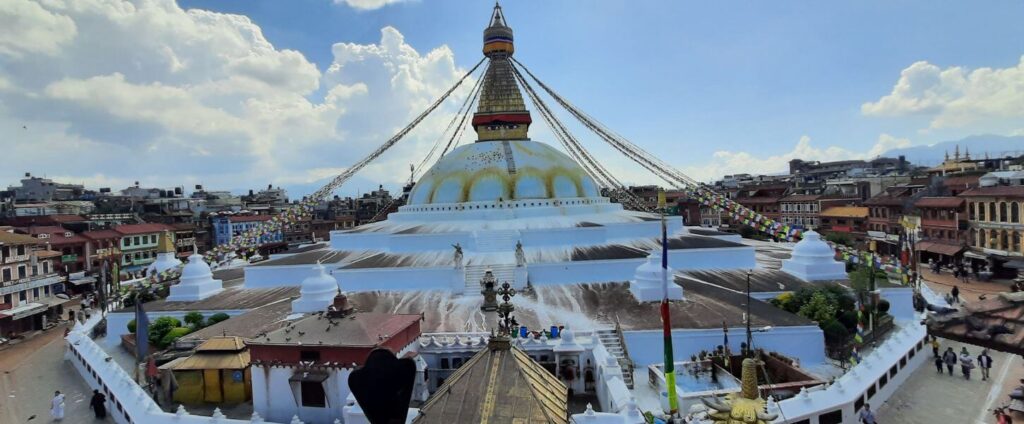
Boudhanath Stupa is located 11 kilometres northeast of Kathmandu’s centre. Since the fifth century, it has stood solidly on the skyline, overwhelming it with its purity and beauty. It is the biggest spherical stupa in Nepal and one of the biggest stupas in all of Asia.
Boudhanath is a highly well-liked tourist site. More than 50 monasteries surround a sizable population of Tibetan refugees and Buddhist pilgrims around the stupa complex. Tibetan exiles inspired the architecture of the monasteries.
One might experience friendly and happy sentiments because of the environment’s purity and tranquillity. The aroma of various incense fragrances fills the air surrounding Boudhanath. Because of the different Tibetan chants and mantras being recited by Tibetan and Buddhist pilgrims and monks, the ambience appears to be more clean, spiritual, and courteous.
This stupa attracts many travellers from both local and foreign countries, making it a well-known tourist attraction. People around join the locals for Kora in the morning and evening for a loving atmosphere. The kora is a clockwise round trek around the stupa.
This stupa was included in the Kathmandu Valley’s list of World Heritage Sites by UNESCO in 1979. It is well-known for its aesthetic appeal, tranquillity, and spirituality.
The Boudhanath complex has several fast-food restaurants, coffee shops, and gift shops. Restaurants and cafés with rooftop patios offer stunning views of the stupa.
Around the Boudhanath stupa, the evening is always a pleasant and courteous time.
Backstory of Boudhanath
Before the Panchayat era, locals knew Boudhanath by its actual name, Khasti Mahachaitya, which translates to the “huge stupa of dewdrops.” However, King Mahendra officially renamed it Boudhanath during the Panchayat regime in the 1960s.
Historical records indicate that Tibetan ruler Song Tsen Gampo constructed the first stupa at Boudhanath after he embraced Buddhism in 600 AD. Eventually, Mughal kings demolished the original structure.
Despite early destructions, the Gopalaraja-vamsawali credits the Lichhavi king Sivadeva with building the stupa in the fifth century. Historians link several rulers to its construction. Furthermore, several Nepalese chronicles state that King Manadeva built this monument during his reign. Later, archaeologists discovered Amshu Verma’s remains here in the late 15th and early 16th centuries. Numerous tales and legends also surround the building of this historic stupa.
Surrounding Shrines and Parks
The elegant site draws large numbers of visitors, uniquely conveying valuable religious knowledge and culture in a calm, dynamic setting. Other significant locations around Boudha Stupa include the Ajima Temple, a shrine dedicated to the goddess Mamo Pukasi, who guards the stupa region from its north side. Every morning, local priests walk to Ghoyolisang Peace Park to perform their religious duties. Local people historically named this green space the “history pond” because builders used dirt from this exact location to construct the Boudha Stupa.
Architectural Structure
Architects design the Boudhanath Stupa in the traditional shape of a mandala, serving as a three-dimensional representation of Buddha’s journey to enlightenment:
-
Base: Represents Earth.
-
Kumbha (White Dome): Represents water.
-
Spire: Represents air.
-
Top Umbrella: Represents the vacuum.
-
Thirteen Spires: Represent the 13 phases humans must travel through to reach Nirvana.
The 2015 Earthquake and Restoration
The severe earthquake in April 2015 severely damaged this enormous stupa. Restoration efforts officially started on November 3, 2015, driven by the Boudha Area Development Committee, which successfully rebuilt and renovated the monument. Buddhist organizations and generous volunteers funded rehabilitation projects. On November 22, 2016, Prime Minister Pushpa Kamal Dahal formally opened the newly restored stupa to the public.
Management and National Protection
The Ancient Monuments Preservation Act of 1956 recognizes the selected site as a protected monument zone, offering the highest national level of protection. Central, local, and non-governmental organizations jointly manage the property, following powers and duties outlined in the Integrated Management Plan for the Kathmandu World Heritage Property adopted in 2007.
Officials conduct five-year reviews of the management plan’s execution to provide necessary adjustments reflecting evolving conditions, ensuring that comprehensive disaster risk management remains a top priority.
Other Fascinating Sites Around Boudhanath Stupa

Indeed, within the boundaries of Boudha Stupa, visitors discover several Gumba and monasteries. Specifically, His Eminence Kachen Yeshi Gyaltsen established Samteling Monastery, which stands as the first Tibetan monastery and one of the four principal lineages. Furthermore, this monastery belongs to the Geluk tradition, upholding unique chanting and ceremonial practices. Similarly, Chyopge Thichen founded Jhamchen Lhakhang Monastery in 1989, preserving ritual practices from the Sakya tradition. Moreover, Master Dazang Ngeden Chhoeki Ngima Palsangpo constructed the Dilyak Yebam monastery in 1966. Here, monks perform all essential Buddhist rites. Additionally, locals know this location as Guru Marmen Lhakang, aligning with the Kagyud sect while serving as one of the oldest Nyingma monasteries housing magnificent statues. Meanwhile, indigenous Tamang and Chiniya Lama communities actively carry out various traditional and ceremonial activities.
Festivals Celebrated at Boudhanath Stupa
Undoubtedly, the most important and fascinating period arrives when Boudhanath Stupa celebrates numerous vibrant festivals. For instance, locals and pilgrims observe events like Mamla Jatra (January/February), Chechyu Puja (December/January), Loshar (mid-January to February), Temal Jatra (March/April full moon), Ropai Jatra (August full moon), and Buddha Jayanti (April/May). Thus, these celebrations showcase rich cultural heritage.
Plan Your Visit with Attractive Travels
Ultimately, the Attractive Travels team offers a variety of appealing locations across Nepal, including Boudhanath. Therefore, if you intend to visit this famous holy site, please feel free to contact us.
Frequently Asked Questions
Q1. What makes Boudhanath Stupa unique?
Indeed, guardians keep the relics and bones of Buddha inside the semicircular Boudha stupa. Consequently, its enormous mandala ranks the stupa among the biggest spherical monuments worldwide.
Q2. What is improper behavior in Buddha’s presence?
Always honor the Buddha statues. Specifically, never approach a Buddha statue, the raised platform it sits on, or climb on it. Moreover, avoid taking photos during worship without first obtaining permission.
Q3. How frequently do you circle a stupa?
Typically, practitioners make three rounds around the stupa while praying and wishing the best for everyone. Beliefs suggest that simply approaching a stupa unlocks its blessing and soul-cleansing power.
Download PDF